



-

- DISCOVER SIKHISM
- SIKH GURUS
- Sikh Gurus
- Sri Guru Nanak Sahib Ji
- Sri Guru Angad Sahib Ji
- Sri Guru Amar Das Sahib Ji
- Sri Guru Ram Das Sahib Ji
- Sri Guru Arjan Sahib Ji
- Sri Guru Hargobind Sahib Ji
- Sri Guru Har Rai Sahib Ji
- Sri Guru Harkrishan Sahib Ji
- Sri Guru Tegh Bahadur Sahib Ji
- Sri Guru Gobind Singh Sahib Ji
- Sri Guru Granth Sahib Ji
- GURDWARAS
- SIKH LIBRARY
- DAILY HUKAMNAMA
- MORE
- KIRTAN
- LIVE TV
- ABOUT US

1984 Delhi Sikh Genocide - Official Investigations
|
|
|
|
|
|
|
|
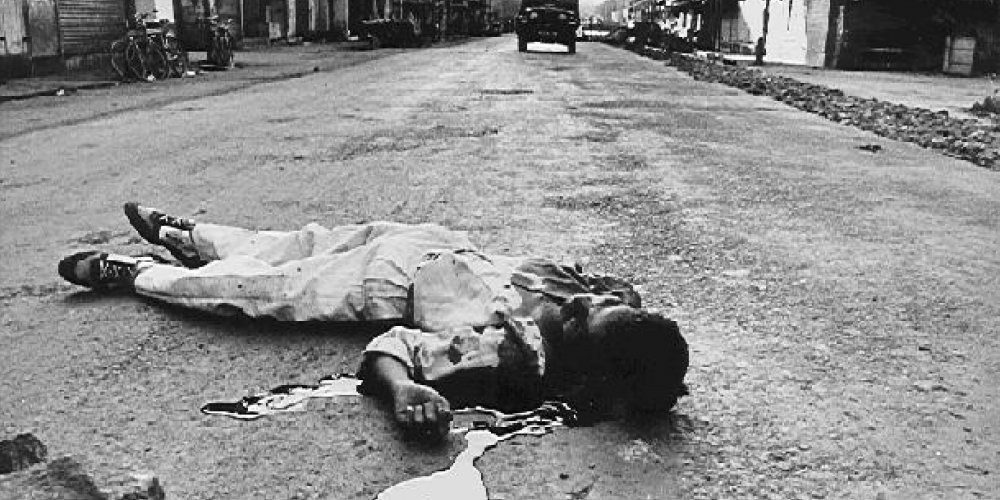
Numerous official commissions were set up to investigate the 1984 Sikh genocide, most (if not all) were inadequate miscarriages of justice. The last major commission on the 'pogroms', headed by Justice G.T. Nanavati, submitted its 185-page report to the Home Minister, Shivraj Patil on 9 February 2005 and the report was tabled in Parliament on 8 August 2005.
Ten commissions and committees have so far enquired into the Sikh genocide. The commissions below are listed in the order they were formed. Many of the primary accused were acquitted or never charge-sheeted.
Marwah Commission
This commission was appointed in November 1984. Ved Marwah, Additional Commissioner of Police, was assigned the job of enquiring into the role of the police during the carnage of November 1984. Many of the accused officers of Delhi Police went to Delhi High Court. As Ved Marwah completed his inquiry towards the middle of 1985, he was abruptly directed by the Home Ministry not to proceed further. Complete records of the Marwah Commission were taken over by the government and were later transferred to the Misra Commission. However, the most important part of the record, namely the handwritten notes of Mr Marwah, which contained important information, were not transferred to the Misra Commission.
Misra Commission
Misra commission was appointed in May 1985. Justice Rangnath Misra, was a sitting judge of the Supreme Court of India. Justice Misra submitted his report in August 1986 and the report was made public six months thereafter in February 1987. In his report, Justice Misra stated that it was not part of his terms of reference to identify any person and recommended the formation of three committees.
The commission and its report was criticised by People's Union for Civil Liberties and Human Rights Watch as biased. A Human Rights Watch report recording the Misra Commission noted:
It recommended no criminal prosecution of any individual, and it cleared all high-level officials of directing the pogroms. In its findings, the commission did acknowledge that many of the victims testifying before it had received threats from local police. While the commission noted that there had been "widespread lapses" on the part of the police, it concluded that "the allegations before the commission about the conduct of the police are more of indifference and negligence during the riots than of any wrongful overt act."
People's Union for Civil Liberties criticised the Misra commission for keeping information on the accused secret while revealing the names and addresses of victims of violence.
Dhillon Committee
The Dhillon Committee, headed by Mr Gurdial Singh Dhillon was appointed in 1985 to recommend measures for the rehabilitation of the victims. This committee submitted its report by the end of 1985. One of its major recommendations was that the business establishments, which had insurance cover, but whose insurance claims were not settled by insurance companies on the technical ground that Sikh genocide was not covered under insurance, should be paid compensation under the directions of the government. This committee recommended that since all insurance companies were nationalised, they be directed to pay the claims. However, the government did not accept this recommendation and as a result insurance claims were rejected by all insurance companies throughout the country.
Kapoor Mittal Committee
Kapoor Mittal Committee was appointed in February 1987 on the recommendation of the Misra Commission to enquire into the role of the police, which the Marwah Commission had almost completed in 1985 itself, when the government asked that committee to wind up and not proceed further.
After almost two years, this committee was appointed for the same purpose. This committee consisted of Justice Dalip Kapoor and Mrs Kusum Mittal, retired Secretary of Uttar Pradesh. It submitted its report in 1990. Seventy-two police officers were identified for their connivance or gross negligence. The committee recommended forthwith dismissal of 30 police officers out of 72. However, till date, not a single police officer has been awarded any kind of punishment.
Jain Banerjee Committee
This committee was recommended by the Misra Commission for recommending registration of cases. It consisted of Justice M.L. Jain, former Judge of the Delhi High Court and Mr A.K. Banerjee, retired Inspector General of Police.
|
The Misra Commission held in its report that a large number of cases had not been registered and wherever the victims named political leaders or police officers, cases were not registered against them.
This committee recommended registration of cases against Mr Sajjan Kumar in August 1987, but no case was registered.
In November 1987, press reports criticised the government for not registering cases despite the recommendation of the committee.
In December 1987, one of the co-accused along with Sajjan Kumar, namely Mr Brahmanand Gupta filed a writ petition in the Delhi High Court and obtained a stay against this committee. The government did not oppose the stay.
The Citizen's Justice Committee filed an application for vacating the stay. Ultimately, the writ petition was decided in August 1989 and the high court quashed the appointment of this committee. An appeal was filed by the Citizens Justice Committee in the Supreme Court of India.
Ahooja Committee
Ahooja Committee was the third committee recommended by the Misra Commission to ascertain the total number of killings in Delhi. This committee submitted its report in August 1987 and gave a figure of 2,733 to 3,870 as the number of Sikhs killed in Delhi alone.
Potti Rosha Committee
Potti Rosha Committee was appointed in March 1990, by the V.P. Singh government, as a successor to the Jain Banerjee Committee. In August 1990, Potti-Rosha issued recommendations for filing cases based on affidavits victims of the violence had submitted. There was one against Sajjan Kumar. A CBI team went to Kumar's home to file the charges. His supporters locked them up and threatened them harm if they persisted in their designs on their leader. As a result of this intimidation, when Potti-Rosha's term expired in September 1990, Potti and Rosha decided to disband their inquiry.
Jain Aggarwal Committee
The committee was appointed in December 1990 as a successor to the Potti Rosha Committee. It consisted of Justice J.D. Jain, retired Judge of the Delhi High Court and Mr D.K. Aggarwal, retired DGP of Uttar Pradesh. This committee recommended registration of cases against H.K.L. Bhagat, Sajjan Kumar, Dharamdas Shastri and Jagdish Tytler.
The Committee also suggested setting up of two – three Special Investigating Teams in the Delhi Police under a Deputy Commissioner of Police and the overall supervision by the Additional Commissioner of Police, In-charge – CID and also to review the work-load of the three Special Courts set up to deal with October – November 1984 Sikh genocide cases exclusively so that these cases could be taken up on day-to-day basis.
The question of appointment of Special Prosecutors to deal with October – November 1984 Sikh genocide cases exclusively was also discussed. This committee was wound up in August 1993. However, the cases recommended by this committee were not even registered by the police.
Narula Committee

|
Narula Committee was appointed in December 1993 by the Madan Lal Khurana led BJP government in Delhi. One of the recommendations of the Narula Committee was to convince the Central Government to grant sanction in this matter.
Mr. Khurana took up the matter with the Central Government and in the middle of 1994, the Central Government decided that the matter did not fall within its purview and sent the case to the Lt. Governor of Delhi. It took two years for the Narasimha Rao Government to decide that it did not fall within Centre's purview.
Narasimha Rao Government further delayed the case. This committee submitted its report in January 1994 and recommended the registration of cases against H.K.L. Bhagat and Sajjan Kumar.
Ultimately, despite the delay by the Central government, the CBI was able to file the charge sheet in December 1994.
The Nanavati Commission
The Nanavati Commission was established in 2000 after some dissatisfaction was expressed with previous reports. The Nanavati Commission was appointed by a unanimous resolution passed in the Rajya Sabha. This commission was headed by Justice G.T. Nanavati, retired Judge of the Supreme Court of India. The commission submitted its report in February 2004. The commission reported that recorded accounts from victims and witnesses "indicate that local Congress leaders and workers had either incited or helped the mobs in attacking the Sikhs".
Its report also found evidence against Jagdish Tytler "to the effect that very probably he had a hand in organising attacks on Sikhs". It also recommended that Sajjan Kumar's involvement in the rioting required a closer look. The commission's report also cleared Rajiv Gandhi and other high ranking Congress (I) party members of any involvement in organising riots against Sikhs. It did find, however, that the Delhi Police fired about 392 rounds of bullets, arrested approximately 372 persons, and "remained passive and did not provide protection to the people" throughout the Sikh genocide.
Nov 1984Marwah CommissionSet up to inquire into the role of the police in the carnage. Was abruptly told by the Central government to stop the probe. Records were selectively passed on to next commission. |
May 1985Misra CommissionSet up to probe if the violence was organised. Its August 1986 report recommended the formation of three new committees: Ahooja, Kapur-Mittal, and Jain-Banerjee. |
Nov 1985Dhillon CommitteeSet up to recommend rehabilitation for victims. Asked that insurance claims of attacked business establishments be paid, but government rejected all such claims. |
Feb 1987Kapoor-Mittal CommitteeEnquired, again, into the role of the police. 72 policemen were identified for connivance or gross negligence, 30 recommended for dismissal. No one was punished. |
Feb 1987Jain-Banerjee CommitteeLooked at cases against Jagdish Tytler and Sajjan Kumar, and recommended cases be registered against both. Later, Delhi HC quashed the very appointment of the committee. |
Feb 1987Ahooja CommitteeSet up by Misra Commission to ascertain the number of people killed in the massacre in Delhi. In August 1987, Ahooja's report put the figure at 2,733 Sikhs. |
Mar 1990Potti-Rosha CommitteeAppointed as a successor to the Jain-Banerjee committee. Potti-Rosha also recommended registration of cases against Sajjan Kumar and Jagdish Tytler. |
Dec 1990Jain-Aggarwal CommitteeAppointed as a successor to Potti-Rosha, and also recommended cases against HKL Bhagat, Tytler and Kumar. No cases registered, and probe stopped in 1993. |
Dec 1993Narula CommitteeIn its report in January 1994, it was the third committee in nine years to repeat the recommendation to register cases against Bhagat, Tytler and Sajjan Kumar. |
May 2000Nanavati CommissionOne-man commission appointed by the BJPled government. Found "credible evidence" against Tytler and Kumar. The CBI is now trying to give a clean chit. |
Why Did Rajiv Gandhi Refuse Inquiries Into Genocide?
Every time there is a law and order outrage, there is inevitably a demand for a judicial inquiry. That is, an inquiry in addition to the regular police investigation. Those who demand such an inquiry feel the police cannot be trusted to do a proper investigation either because they are very much a part of the administration or because their own role is under question. The Government often has its own motive for acceding to the inquiry demand: To defuse the tension and avert further problems. Thus, there have been hundreds of judicial inquiries around the country especially since a law was enacted for that purpose way back in 1952.
The subjects of inquiry have been varied. They have ranged from police brutalities and emergency excesses to political assassinations and communal riots. Each of such issues has been deemed to be a "definite matter of public importance," the sole criterion laid down by the Commissions of Inquiry Act, 1952. But in terms of sheer intensity of violence, the number of people murdered, none of those matters can compare with the massacre of some 4,000 Sikhs in Delhi over three days in 1984. The official death toll announced three years after the massacre was 2,733. Since the Partition riots of 1947, there has not been a single carnage anywhere in India on the scale seen in 1984, ironically right in its Capital.
Therefore, it would seem, there has been no fitter case for inquiry than the Delhi massacre. Yet, it took a long time for the Government to accede to the inquiry demand. Almost six months. Though the massacre took place in the first three days of November 1984, the inquiry was appointed only on April 26, 1985. The Government was however prompt in ordering an inquiry into Indira Gandhi's assassination, which had triggered the massacre.
It took just four days to announce a judicial inquiry into the assassination. Why did the Government not show the same kind of urgency about the massacre of 4,000 Sikhs? Why the distinction at the same time between the murder of one and the murder of many? Was there not enough pressure on the Government to hold an inquiry into the massacre as well? No, the victims, Opposition parties, Sikh organisations, newspapers and human rights groups did clamour for an inquiry again and again.
Congress Was Squarely Responsible
But then the problem for the newly formed Rajiv Gandhi Government was that a lot of those very people were equally vehement in alleging that the massacre had been organised by leaders of the ruling Congress party. On November 9, Atal Behari Vajpayee, who was then the president of the Bharatiya Janata Party, which is the main rival to Congress in the local politics of Delhi, said that the disturbances were "in the main engineered violence and the Congressmen are squarely responsible for this." Deploring the Government's failure to accede to the "near unanimous demand" for a judicial inquiry, he said he regarded it as "the Government's guilty conscience and an eagerness to shove its own sins beneath the carpet."
While the Government ignored Vajpayee's charge, the Congress party counter-attacked by saying, "Who is not aware of the anti-minority bias of parties like the BJP? No right thinking person can be taken in by their false and misleading propaganda." Given such protestations of innocence, one would have expected Rajiv to seize the opportunity of a judicial inquiry to clear, if nothing else, the name of his party and government. If he did no such thing, was it because Rajiv actually had so much to hide that he would rather bear the stigma of suspicion than risk a judicial inquiry, while the wounds were still so fresh and the evidence so much easier to find? Or, was it simply that he was pandering to the wrath of those Hindus who saw the massacre as a richly deserved lesson to the Sikhs.
Whatever his motive, Rajiv could at that stage disregard the allegations of political complicity because they were yet to be supported by details such as the names of the leaders and the nature of their alleged involvement. The only name that came out in the press initially was of a Congress MP from Delhi, Dharam Das Shastri, who was reported to have led a mob to a police station on November 5 and berated the officers for arresting killers. Shastri's gratuitous concern for the miscreants fitted in, on the face of it, with the allegation that Congress leaders had organised the violence. A delegation of Opposition leaders highlighted Shastri's indiscretion the next day in their joint memorandum to Rajiv, who refused however to see it as anything but an isolated incident of political involvement.
Taking Advantage Of Genocide
An overall account of the role played by politicians came out for the first time on November 15 when two human rights organisations, People's Union for Democratic Rights (PUDR) and People's Union for Civil Liberties (PUCL), published a joint report entitled, Who are the guilty? More significantly, it named the Congress leaders who had apparently been identified by victims and witnesses as organisers of the Sikh genocide. The report created a sensation alright but only momentarily. That's because the Government had by then called the Lok Sabha elections, drowning out the commotion over the inquiry demand.
The poll was fixed for December 27, a fortnight ahead of the due date. The election announcement made on November 13 put paid to any chances of an inquiry being ordered till at least the electoral process was completed. But, in the run-up to the elections, Rajiv had to explain his stand on the massacre and the inquiry demand on more than one occasion. Except that he kept taking varying and often conflicting positions.
Excuses For Genocide
First, he provided a rationale to the massacre which made the inquiry demand sound rather misplaced. It was that famous comparison he made of the massacre with the impact of a big tree falling on the earth. The official translation of his Hindi speech on Indira Gandhi's birth anniversary says: "Some riots took place in the country following the murder of Indiraji. We know the people were very angry and for a few days it seemed that India had been shaken. But, when a mighty tree falls, it is only natural that the earth around it does shake a little." In other words, he was plugging the line that the three-day massacre in Delhi of 4,000 Sikhs was entirely a spontaneous reaction of the mourners.
But in the course of his election campaigning, Rajiv gave another spin to the massacre. He repeatedly said that the motive behind Indira's assassination was to provoke widespread communal violence as part of a grand design to break up the country. The implication being that the perpetrators of the communal violence were themselves victims of a conspiracy as much as the Sikhs they massacred were. Though Rajiv was in effect attributing the assassination and the consequent massacre to a common conspiracy, the terms of reference of the Justice M.P. Thakkar commission set up by him to unravel the conspiracy behind the assassination made no reference whatsoever to the massacre.
In his interaction with the press during the electioneering, Rajiv took yet another position whenever he was asked about the inquiry demanded into the alleged involvement of his party leaders in the Delhi massacre. Recalling the meeting he had with the Opposition leaders on November 6, he said they could name only one leader and he took action on that basis.
The leader Rajiv was referring to was none other than Dharam Das Shastri and the action taken against him was that he was not renominated as a Congress candidate in the election. The implication of Rajiv's reply to the press was: since he had denied the Congress ticket to Shastri, there was no more any need for a judicial inquiry into the massacre.
However untenable and inconsistent his reasoning might have been, Rajiv's evasion of the inquiry turned out to be in tune with the popular mood in the election, held as it was under the shadow of Indira Gandhi's assassination and the massacre of Sikhs. Thanks to the overwhelming mandate he received from the electorate (more than 90 per cent of the seats in the Lok Sabha), Rajiv's insensitivity to the genocide victims seemed to have turned into contempt for them.
The customary condolence motions passed by the new Lok Sabha referred to Indira Gandhi and even the victims of the Bhopal industrial disaster that took place in December 1984. But those killed in the massacre that followed Indira's assassination were conspicuously overlooked. It was as though Rajiv wanted to avoid any gesture that might have been construed to legitimise the inquiry demand.
Sikhs Still Under Threat
In an interview to India Today in January 1985, he said the inquiry would not help as it would only rake up "issues that are really dead." That was a singularly unkind metaphor. He had never before been so derisive of the inquiry demand nor so dismissive of the value of an independent probe into the massacre.
As if that was not bad enough, Rajiv went on to give a sinister twist to the inquiry demand in an interview to Sunday magazine around the same time. He said an inquiry was not being instituted as "it would do more damage to the Sikhs, it would do more damage to the country by specifically opening this whole thing up again." It sounded as though he was giving a veiled threat to the victims that they could get into worse trouble if they pressed for an inquiry.
For all the vehemence with which he ruled out the inquiry, Rajiv soon had to eat his words due to his administrative compulsion. He had won the election positioning himself as the best bet to save the country from being consumed by the raging Punjab militancy. As a natural corollary, he declared right after the election that his "top priority" was to settle the Punjab problem at the earliest.
The key to that problem lay in opening a dialogue with the Akali Dal leaders who had been in detention since the crackdown that followed Operation Bluestar in June 1984. The Government released them from detention but found that they were unwilling to deal with it. The Akali leaders refused to talk with the Government until it proved its bona fides by setting up a judicial inquiry into the 1984 massacre.
Rajiv no doubt found it difficult to consider that pre-condition because of his avowed policy of shunning the inquiry. Besides, the no-inquiry policy was an important part of the winning formula in the December 1984 Lok Sabha election. He was under pressure to leave that formula undisturbed for the assembly elections in several states barely three months later. It was after all vital for the new Prime Minister to show that his maiden triumph was no fluke and that he still commanded popular support.
Political Manoeuvring
Thus, only after he tided over the assembly elections in March 1985, did Rajiv allow his administrative exigency to take precedence over his political posture. The first indication came when he sent a Cabinet panel at that stage to Punjab where his home minister, S.B. Chavan, declared that the inquiry could well be considered as part of a package settlement. But as the Akalis maintained that the inquiry would have to be appointed before the talks on the Punjab problem, Rajiv petulantly asked in an interview to Frontline in April 1985: "Well, there is something basically wrong here, because isn't that what we are going to talk about? If it's already done before we talk, then what are we talking about?" He was eager to talk about the inquiry with the Akali leaders because, as he put it then to the British publication Observer, "we would like them to come forward and say exactly what they want now."
The politician in Rajiv had dismissed the inquiry demand outright just a few weeks earlier saying it would only rake up dead issues and do more damage to the Sikhs and the country. The administrator in him was now trying to use the inquiry issue as a bargaining counter in the negotiations he proposed to have with the Akali leaders for an accord on Punjab. There was however a stalemate as the Akalis refused to talk until the inquiry was appointed. They sought to exert pressure on the Government by threatening to launch a major agitation on April 13, the anniversary of the Jallianwala Bagh massacre.
The Government gave in just two days before the threatened agitation when Chavan announced in Parliament a package of measures to "restore normalcy in Punjab." One was the release of some more Sikh detainees and another was the lifting of the ban on a militant Sikh student organisation. The third and the most important measure announced in that context was the decision to hold a judicial inquiry into the Delhi massacre.
Fake Gestures
Thus, the Rajiv Gandhi Government made no bones about the fact that the inquiry demand was finally conceded merely to clear the way to an accord on Punjab with the Akali Dal. There was no pretence whatsoever that it had suddenly found the inquiry demand to be just. But then, strictly speaking, the Government's attitude should not matter any longer once an inquiry commission is appointed. The inquiry takes its own course regardless of what anybody feels.
Its job is to find facts and make recommendations. The commission enjoys as much independence from the executive as the court does. The Government can have its way only after the commission is done with the inquiry. The Government has the discretion to accept or reject the commission's findings and recommendations. Given the moral weight of a report written by a judge after due inquiry, the Government is generally hard pressed to justify any disagreement with the Commission.
The Rajiv Gandhi Government did not however face any such embarrassment on account of the inquiry report on the 1984 massacre. Although it found that "a number of people belonging to the Congress (I) party at the lower level had participated in the riots," the report absolved the party leaders of the allegation of organising the massacre.
Serious Allegations
The Commission headed by a serving Supreme Court judge, Ranganath Misra, did however confirm some other serious allegations:
1. that for three whole days the mobs had a free run of the place murdering, looting and raping hundreds of Sikhs;
2. that the administration in the Capital had all but collapsed;
3. that the police either looked the other side or joined the mobs;
4. that there was an undue delay in imposing the curfew as well as in calling the army;
5. that the pattern of violence indicated that it was organised;
6. that the police either refused to entertain the complaints of the victims or registered them only after deleting the names of influential people;
7. that the police and the killers harassed the victims even during the inquiry to prevent them from deposing before it.
Yet, the Misra Commission held that the culprits in the Congress party behind the massacre were only workers and not leaders.
How did the Commission come up with such a finding in the face of all those facts suggesting otherwise?
How did it reconcile the blanket exoneration of the Congress leaders with, say, the controversy over Congress MP Dharam Das Shastri who allegedly stormed a police station with a mob to secure the release of other killers?
What could the Congress party have deposed in its defence which made the Commission dissociate the leaders from the workers?
What was that strong evidence which convinced Misra that the party workers were more likely to have acted on their own, without any instigation or organisation from their leaders?
What exactly did the leaders and the workers say about each other during their cross-examination?
What action did the party show to have taken against the delinquent workers and did it assume moral responsibility for their crimes?
Answers?
The answers to these questions should logically have figured in the inquiry report on "the allegations in regard to the incidents of organised violence." Equally obvious, no such inquiry could have been completed without the participation of the very people who were alleged to have organised the violence. Namely, the Congress leaders and workers identified by the victims in their affidavits before the Commission.
The leaders included H.K.L. Bhagat, who was a minister in the Rajiv Gandhi Government, and Sajjan Kumar and Dharam Das Shastri, former Congress MPs, and several Delhi legislators. But, as it happened, Misra did not throughout the inquiry call any of those Congress members nor for that matter any representative of the party.
Misra's failure to put a single political leader through the wringer of cross examination contrasts with the conduct of other inquiries held into similar issues. Take the case of the B.N. Srikrishna Commission which inquired into the Bombay riots of 1992-93 in the wake of the Babri Masjid demolition. The Srikrishna Commission on its own initiative put in the witness box Shiv Sena leader Manohar Joshi, who had by then become chief minister of Maharashtra, and Congress leaders, Sudhakar Naik and Sharad Pawar, who were at the time of the riots Maharashtra chief minister and Union defence minister, respectively.
Shielding Congress Members
Far from asserting his power to call anybody as a witness, Misra went out of his way to keep the Congress members out of the proceedings even at the cost of violating the law. Section 8-B of the Commissions of Inquiry Act stipulates that the Commission cannot probe the conduct of any person without giving him an opportunity to be heard and to defend himself. The allegations made by the victims were very much about the conduct of the Congress members.
Misra should therefore have given them an opportunity to defend themselves by issuing Section 8-B notices to them. None of the Congress members however objected to his failure to do so. The fact that they forsook their right to defend themselves implied two things. One, they feared they would only be exposed further when cross examined by the lawyers of the victims. Two, they had the confidence or foreknowledge that Misra would somehow vindicate them even in the absence of their defence.
Affidavits Against The Victims
Thus, by shielding the Congress members from his own proceedings, Misra has clearly engaged in a fix-it inquiry. Nevertheless, he had to find some other way of countering all those nasty affidavits from the victims. He did so in his own free wheeling manner with the testimony of a third party. Namely, those who filed, as Misra himself put it, "affidavits against the victims."
It was odd enough that any affidavit should have been filed at all against the Sikhs in the context of their own massacre. Not only were such affidavits filed but they also outnumbered those in support of the victims by as many as four times.
All the anti-victim affidavits had the same stereotyped contents asserting that the local MP and other Congressmen had helped the Sikhs. None of them went into specific details of how the Congress leaders had helped the Sikhs during the carnage. But even if their credibility was found acceptable, the anti-victims affidavits could at best have been used to corroborate the defence of the Congress leaders. Misra instead used the anti-victim affidavits as a substitute for the non-existent defence of the Congress leaders, thereby sparing them the risk of facing the cross examination.
Secret Inquiry
Another notable aspect of Misra's fix-it inquiry was, he conducted it throughout in the secrecy of in camera proceedings. Generally, whether it is a court of law or commission of inquiry, the power of holding in camera proceedings is sparingly used so as to maintain the credibility of the proceedings. But, just as the Congress leaders could not risk facing the lawyers of the victims, Misra could not afford to let the press attend his proceedings lest they caught on to his cover-up attempts. When a few reports came out initially despite his ban on the entry of the press, Misra passed an unprecedented order threatening to take action against the newspapers that continue to report the Commission's proceedings.
Later, when he was to examine some public officials in the course of the inquiry, he turned all the more secretive and kept in the dark even the lawyers of the victims. That was the last straw for the Citizens Justice Committee (CJC), the main representative of the victims. It withdrew from the proceedings half-way through the inquiry, causing embarrassment to Misra.
Not the least because the CJC could not be dismissed as a bunch of hot-headed activists since it consisted of highly respected establishment figures such as S.M. Sikri, former chief justice of India, V.M. Tarkunde and R.S. Narula, former high court judges, Soli Sorabjee, senior advocate in the Supreme Court, Rajni Kothari, political scientist, Lt Gen J.S. Aurora, the Bangladesh war hero, and Khushwant Singh, author and columnist.
Judge Accuses Judge
The CJC was formed under the chairmanship of Sikri with the express object of helping the Commission arrive at the truth. But Misra's machinations forced it to walk out saying his unusual procedure only served the purpose of "shielding the culprits and suppressing the truth." In other words, a group headed by a former chief justice of India accused a serving Supreme Court judge of subverting an inquiry by lying and colluding with the powers-that-be. The charge sounds all the more serious considering that the inquiry was into a massacre of 4,000 citizens right in the Capital.
On the eve of the massacre, P.V. Narasimha Rao, who as home minister was responsible for what was then the Union territory of Delhi, assured the press that everything would be under control within a couple of hours. Misra absolved him of any responsibility for the administrative collapse during the three-day massacre. Years later, after Rao became Prime Minister and Misra retired as chief justice of India, Rao made Misra the first chairman of, of all the things, the National Human Rights Commission. Misra has since joined Congress and become its member in the Rajya Sabha.
Rajiv's Insincerity
In April 1989, emboldened by Misra's clean chit to him, Prime Minister Rajiv Gandhi declared in Parliament: "The terrible bloodbath of November 1984 was a carnage which will rest for ever on the conscience of all decent Indians." The material put together shows that the Misra inquiry and the subsequent motions of follow up action were no less a matter that should rest for ever on the conscience of all decent Indians.
For the record, the Misra Commission recommended a committee to look into allegations that many cases were either not registered or not properly investigated. The first proposal the committee made in 1987 was for registration of a murder case against former Congress MP Sajjan Kumar. The police did not act on the committee's instruction. Instead, an associate of Sajjan Kumar obtained a stay from the Delhi high court on the very functioning of the committee.
In October 1989, the high court quashed the very appointment of the committee. About five months later, the V.P. Singh Government appointed a fresh committee minus the defect pointed out by the high court. Subsequently, many cases came to be taken up by the police but because of the delay and cursory investigation less than five per cent of those have resulted in convictions. Most of the convictions were for minor offences like rioting and violation of curfew orders. Needless to add, no political leader has so far been convicted for his complicity in the 1984 massacre.
More Committee's
Meanwhile, there was another committee, again recommended by the Misra Commission, to identify delinquent police officials. A report submitted by one of the two committee members recommended various degrees of punishment to 72 police officials, including six IPS officers. But due to some reason or the other, the Government has so far not taken action against any of the officials.
It was against this dismal background of legal deception and unfulfilled expectations that the Vajpayee Government took the momentous decision in December 1999 to accept the demand for a fresh judicial inquiry into the whole issue of the 1984 carnage. In Parliament, members of all the parties, including the Congress party, passed a resolution supporting the Government's decision in this regard. The subsequent appointment of the Justice G.T. Nanavati Commission is nevertheless an unprecedented development. The Misra Commission earned the dubious distinction of giving such a report that the Government was prompted to order an inquiry into the matter all over again.
Fortunately, despite a lapse of more than 16 years since the carnage, the decision to hold a fresh judicial inquiry has paid off. Hundreds of victims and witnesses responded enthusiastically by filing affidavits and adducing evidence in public hearings before the Nanavati Commission. Though it apparently took a while to locate the old records, the Vajpayee Government has been more forthcoming in disclosing documents related to the decisions taken by authorities during and after the carnage. In the process, a whole lot of new evidence has come to light thanks to the ongoing proceedings of the Nanavati Commission.
For instance, many eminent persons have for the first time been able to put on record how home minister P.V. Narasimha Rao and lt governor of Delhi P.G. Gavai dithered the carnage when asked to take prompt action and call in the Army. Several depositions before the Nanavati Commission have also come up with fresh evidence against Congress leaders H.K.L. Bhagat and Sajjan Kumar for their role in the violence.
New Evidence
As for the complicity of the police, one very significant pattern of evidence that has now emerged is that the first priority of top officers throughout Delhi, from the commissioner downwards, seems to have been to disarm Sikhs and arrest them. The Nanavati Commission's proceedings also yielded documentary evidence (mainly in the form of Kusum Lata Mittal's report) giving the lie to the Misra Commission's finding that the violence escalated because police stations had failed to keep their seniors informed about the gravity of the situation.
A lot of such tell-tale evidence that has come up before the Nanavati Commission as well as official and non-official reports given over the years in connection with the 1984 carnage have been painstakingly put together. It is hoped that the information will, at the very least, serve as a record for posterity and provide insights into how a state that prides itself on being secular and democratic was complicit in a massacre of members of a minority community. It is also hoped that India, conscious of its position in history, will undo the mischief of its politicians and people and help the victims secure justice, howsoever belatedly.
Every citizen concerned about the health of democracy has a vital stake in helping establish the principle that no political party should be allowed to use mass killings to reap a political harvest. The Congress party did it in 1984 victimising Sikhs. The BJP tried to do it in 2002 victimising Muslims. Since he was been appointed to head the inquiry into the Gujarat genocide as well, Justice Nanavati has been conferred, in the eyes of history, a special responsibility to unravel this kind of cynical exploitation of baser instincts. No matter what the outcome of Justice Nanavati's exertions, this information is offered as a humble and heart-felt tribute to the thousands of unknown men, women and children who for no fault of theirs were killed, raped, widowed, orphaned or rendered homeless in India's Capital in those fateful days of 1984.