



-

- DISCOVER SIKHISM
- SIKH GURUS
- Sikh Gurus
- Sri Guru Nanak Sahib Ji
- Sri Guru Angad Sahib Ji
- Sri Guru Amar Das Sahib Ji
- Sri Guru Ram Das Sahib Ji
- Sri Guru Arjan Sahib Ji
- Sri Guru Hargobind Sahib Ji
- Sri Guru Har Rai Sahib Ji
- Sri Guru Harkrishan Sahib Ji
- Sri Guru Tegh Bahadur Sahib Ji
- Sri Guru Gobind Singh Sahib Ji
- Sri Guru Granth Sahib Ji
- GURDWARAS
- SIKH LIBRARY
- DAILY HUKAMNAMA
- MORE
- KIRTAN
- LIVE TV
- ABOUT US

1984 Delhi Sikh Genocide - The Disappeared
|
|
|
|
|
|
|
|
Throughout this period of unrest many thousands of civilians have 'disappeared', leaving their families uncertain as to their fate and with little legal redress, as most lack the resources to take their case to court, and those who are able to do so receive a standard denial of any state wrongdoing.
The 'disappeared' are mostly young men, suspected of being supporters of autonomous sympathisers, who were arrested or abducted by the police never to be seen again, although some women, elderly people and children were also victims.
Despite Indian State claims that these 'disappeared' died in armed encounters with police, or fled abroad, human rights observers recognise that the vast majority of them have been killed in police custody, the term "encounters" in Punjab has become synonymous with extra-judicial executions.
Observers estimate that, since 1984, over 100,000 people have been killed in Punjab and thousands more have suffered torture and illegal detention. The Human Rights and Democracy Forum that was set up to investigate those 'disappearances' found that in just three cremation grounds in the area of Amritsar in Punjab, over 3,000 bodies had been cremated by the police as unclaimed between 1984 and the end of 1994. It is now known that over fifty cremation grounds in Punjab have been used regularly by police to cremate bodies.
The responsibility for a huge amount of these deaths lies with a variety of Indian State forces, including the Army, the Border Security Force, the Central Intelligence Agency, the Central Reserve Police Force, and, most of all, the Punjab Police, who the European Court of Human Rights described as "accustomed to act without regard to the human rights of suspect[s]". - Application No. 70/1995/576/662, Strasbourg, 15th November 1996.
"Thousands of Sikh homes in the Punjab villages have been raided by the police and paramilitary forces. Young Sikhs have been dragged away for questioning never to be seen again" - The Guardian.
"The pattern in each village appears to be the same. The army moves in during the early evening, cordons a village, and announces over loudspeakers that everyone must come out. All males between the ages of 15 and 35 are trussed and blindfolded, then taken away. Thousands have disappeared in the Punjab since the army operations began. The government has provided no lists of names; families don't know if sons and husbands are arrested, underground or dead." - Mary Ann Weaver, Christian Science Monitor.
The Missing Thousands of Punjab
Thirty years on from the Indian army's invasion of the Golden Temple in June 1984, the relatives of those who were "disappeared" in the years after the attack feel their cause has been abandoned, reports the BBC's Jastinder Khera from Amritsar.
Satwant Singh Manak says he saw 15 people killed by his colleagues when he was serving in the Punjab police - but it was the last that cemented his sense of betrayal, and led him to turn his back on the force.
Kulwant Singh Kanta was a teenager who was detained by the police in April 1992 after a neighbour accused him of having joined a militant group.
"They tortured him for three days. Then they took him to a canal and killed him along with another detainee," Satwant Singh recalls. "They threw his body in the canal."
Satwant Singh was in the police in the late 1980s and early 1990s. Rights groups estimate that during this time, alongside the serious abuses committed by Sikh militant groups, thousands of Sikhs were "disappeared" by the security forces.
He says the killings he witnessed were "fake encounters" - occasions in which the police would kill detainees and claim afterwards there had been a gun battle.
Costly Fight
He says he stayed in the police in the hope that the force's conduct might improve. But after Kulwant Singh's killing, he left and later launched legal action against the officers he alleges were responsible for the deaths.
The families of 10 of the dead have joined his petition.
Satwant Singh says that after leaving the police, he himself was detained and tortured and that his father also died from the effects of police interrogation.
In 2008 a judge at the Punjab High Court allowed his petition and ordered an investigation into the killings.
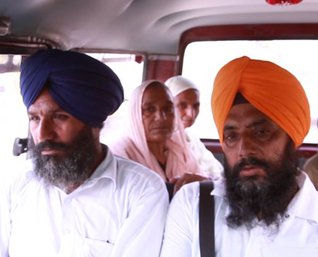
Ex-policeman Satwant Singh (left) is now fighting the police in the courts - travelling to court with the relatives of those who were killed by his colleagues. |
However, in November different judges at the High Court upheld an appeal made by the police officers he had accused. They said Satwant Singh was motivated by a "personal grievance" against his superiors and ordered him to pay costs of 2,000 rupees (£20; $34) to each of the officers.
His lawyers point out that similar arguments were made against the police whistleblower who testified after the 1995 murder of prominent human rights lawyer Jaswant Singh Khalra. Five police officers were eventually convicted of that murder.
Satwant Singh is now taking his case to India's Supreme Court.
It has been a costly fight in many ways - he sold his house to pay the legal fees - and one that he says that Sikh communities abroad have helped him with more than Sikh institutions inside India.
The organisation helping Satwant Singh in bringing his case is Ensaaf (Punjabi for "justice"), a human rights group based in California.
Some argue that diaspora Sikh groups are nurturing resentment over abuses that many Sikhs in Punjab itself have now forgotten.
"Those in India who talk about forgetting the abuses and moving on are normally those who were not directly affected," says co-director and co-founder of Ensaaf, Jaskaran Kaur.
"Also we should remember that many of the officers accused in these cases are still in post, and some witnesses have complained of harassment. We in the diaspora don't have that fear to deal with," she adds.
Jaskaran Kaur believes that bringing human rights violators to account "is about strengthening the country. It's good for India to uphold its own laws and human rights provisions in these cases".
Village Of The Missing
One place where people have not forgotten those years is Sangna, on the outskirts of Amritsar.
At first sight, it is a typical quiet Punjabi village. Birdsong rises above the sound of lowing cattle and children playing in the yards.
But there are absences in the houses here.
Softly spoken Khajan Singh recalls the day in March 1989 when he heard his eldest brother Sukhdev had gone missing.
"He was on a bus on his way to Amritsar. The police had a checkpoint on the road and took him off."
Sukhdev had a full beard and a round saffron turban, the latter worn by more religious Sikh men, and Khajan believes this was the only reason he was picked out.
He denies that his brother was involved in any militant activity.
Sukhdev was the family's breadwinner and, as with many families of disappeared people, the consequences of his disappearance were felt for years afterwards. Khajan and his other brother stopped school and began working and the family sold some of their land to raise money.
Now only Khajan and his ailing mother are left in the family home.
Latent Sentiment
So why have the events of that time slid down the political agenda in Punjab?
Jagtar Singh, a veteran former journalist who has written a book about the insurgency, says that many in Punjab have moved on and simply do not want to remember a very traumatic period in the state's history.
For most of the time since the end of the insurgency, the Sikh Akali Dal political party has been in power in Punjab. It has previously pledged a judicial inquiry looking into various aspects of the period, but quietly shelved this promise once in office.
Jagtar Singh says there is a "latent sentiment" of grievance among some Sikhs which occasionally comes to the fore, most recently in 2012, when widespread protests were sparked by the prospect of the execution of political prisoner Balwant Singh Rajoana.
That there is a more general sense of discontent in Punjab with the Akali-led state government is evident from the recent general election results.
Whereas most of the rest of India saw a thumping victory for the BJP - to which the Akali Dal is allied - in Punjab the alliance's share of the vote actually went down.
The new anti-establishment Aam Aadmi Party (AAP) won four seats in Punjab, its only victories in the whole of India.
One of AAP's candidates was a prominent Sikh human rights lawyer, but the central plank of its campaign was not historic abuses but instead more current grievances with the Akali-led state government: corruption allegations, lack of healthcare provision and employment opportunities, as well as the state's fast-growing drug addiction problem.
Back in Sangna, the twists of Punjabi politics feel very far removed from Kashmir Kaur's house as she watches her grandchildren play at her feet.
Her husband Surjit Singh went missing in 1992 when two policemen took him away just after dawn, saying they needed him to give them directions. She never saw him again, but his name appeared in a list of people whose bodies had been illegally cremated which came to light in 2006.
"We need justice. When they were little, my children used to ask me where their father had gone. Now these little ones ask me where their grandfather is."
As the legacy of the disappeared recedes from the spotlight, there may still be another generation which will have to contend with it.