




- DISCOVER SIKHISM
- SIKH GURUS
- Sikh Gurus
- Sri Guru Nanak Sahib Ji
- Sri Guru Angad Sahib Ji
- Sri Guru Amar Das Sahib Ji
- Sri Guru Ram Das Sahib Ji
- Sri Guru Arjan Sahib Ji
- Sri Guru Hargobind Sahib Ji
- Sri Guru Har Rai Sahib Ji
- Sri Guru Harkrishan Sahib Ji
- Sri Guru Tegh Bahadur Sahib Ji
- Sri Guru Gobind Singh Sahib Ji
- Sri Guru Granth Sahib Ji
- GURDWARAS
- SIKH LIBRARY
- DAILY HUKUMNAMA
- MORE
- LIVE KIRTAN
- LIVE TV
- ABOUT

1984 Delhi Genocide - Tireless Warrior
|
|
|
|
|
|
|
|

For 30 years, Harvinder Singh Phoolka has fought a lonely battle to get justice for the victims of the 1984 anti-Sikh riots. Brijesh Pandey on the man who refuses to give up.
It is a hot afternoon on 10th April. But the rising mercury is not the only reason why tempers flared in the capital. Outside the Karkardooma Court in east Delhi, a landmark judgement is announced to the media and the small crowd has gone berserk.
At stake is the political career of a senior Congress leader and potential embarrassment to the party. For a thousand others, it is the belief that there is still hope, that justice though delayed, would not be denied them.
Harvinder Singh Phoolka wears a smile on his face. The court has just set aside the trial court's verdict and asked the CBI to re-investigate the role of Jagdish Tytler in the killing of three people in the Pul Bangash area of north Delhi during the anti-Sikh riots of 1 November 1984.
Fighting 30 years for what seemed like a lost cause, can test anyone's patience. After relentlessly pursuing justice for the 1984 victims without charging a penny, the 58-year-old has earned his right to smile.
Political games played out as soon as the judgement was announced. For long on the back foot over the 2002 Gujarat riots, the BJP did not lose the opportunity to give one back to the Congress. "It was not a fight between two communities, but a Congress-sponsored massacre," said Smriti Irani of the BJP.
Other parties have joined the chorus. CPM Politburo member Brinda Karat says that the case should be reopened. "But the evidence has been sabotaged," she adds. "They have protected those who the victims named.
In any case, we were against the closure report." Karat was referring to the CBI closure report of 2009, which had given a clean chit to Tytler.
On 1 November 1984, Congress leaders Tytler, Sajjan Kumar and HKL Bhagat had allegedly incited irate mobs to avenge the assassination of Indira Gandhi at the hands of her Sikh bodyguards. The carnage that followed has bloodied the pages of Indian history.
Around 11,000 Sikhs were massacred, of which 3,000 were in Delhi alone. A Tehelka exposé (Carnage 84: The Ambushing Of Witnesses; 8 October 2005, by Ajmer Singh and Etmad A Khan) had shown how Tytler, Kumar and Bhagat had manipulated and bought witnesses to dilute the case.
But this is Phoolka's moment. The OB vans outside his Defence Colony house in south Delhi tell the story. Phoolka has just finished a 30-minute session with a TV channel and is getting ready for another.
His itinerary is packed for the rest of the evening, during which Phoolka will explain to TV channels what this judgement could mean for the 1984 riot victims.
It is clear that by talking of the riots, the delays, the subversions, the pressures, the struggles and the horror, he is in a way reliving his own past, his own struggles. "This judgement is important because it proves that nobody is above the law of the land," he says in between TV interviews.
HS Phoolka, a 28-year-old lawyer when the riots broke out, was on his way back home from Connaught Place in central Delhi when a young Hindu warned him about attacks against Sikhs on Aurangzeb and Tuglaq roads. Phoolka's wife Maninder Kaur was four-months pregnant then.
The owners of the house they stayed in South Extension, the Bahris, hid them in the storeroom when mobs came looking for them. Then, inexplicably, they were asked to move out.
The incident shook Phoolka to the core. People advised him to cut his hair and shave his beard. He refused and had to seek shelter in other places. Finally, he managed to escape to Chandigarh with his wife, by sitting in the cockpit of a plane.
Phoolka had made up his mind to leave Delhi forever. But for a visit to a relief camp. "It set off a chain of events that changed the course of my life," he recalls.
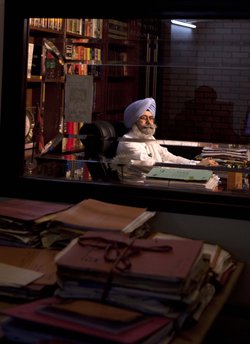
Harvinder Singh Phoolka |
An acquaintance told him about the need for legal aid to riot survivors in Farash Bazaar, east Delhi, the worst riot-affected district.
Phoolka describes this visit as gut-wrenching. "They needed a lawyer so badly that I changed my mind then and there about quitting Delhi and started to help them in filling their forms and preparing their affidavits." Phoolka's wife Maninder stood by his side during all his trials.
During his fight, his family was visited by a tragedy when his son was diagnosed as a "slow learner". There were no facilities in India for his education. Maninder had earlier declined a fellowship to the US because of Phoolka's court battles.
In fact, his wife's sacrifices made Phoolka even more determined in his fight for justice. "My wife is the sole reason behind my tenacity," he says.
Phoolka has detailed his fight and all that he underwent both as an individual and a lawyer in a book he co-authored with senior journalist Manoj Mitta. Mitta has followed the 1984 carnage and the progress of the trial very closely. He calls Phoolka an inspiring man with exemplary single mindedness.
"It was a long and lonely road," says Mitta. "He had support from some quarters like the Sikh Gurdwara Committee, but that too was unreliable. It all depended on who was president of the committee at that time. There were times when explanations were sought on how the money was being spent. Phoolka had to go through all that. It was instructive to see his tenacity, which ultimately paid off."
Despite monetary issues, what puzzles Phoolka most is the "double standards" of the Congress party. "This government keeps on talking about secularism and the 2002 riots in Gujarat," he says. "What about 1984? Were the Sikhs killed during the riots not human beings?"
He also accuses the government of trying to sabotage the cases by using the CBI. "First, they filed a closure report in a great rush in 2007," he says. "It was only when the media traced the witnesses and they agreed to give their statements, that a further investigation was ordered.
In 2009, they again filed the closure report. The then CBI joint director Arun Kumar (currently ADG, Law & Order, UP) decided to file the charge sheet but was overruled by his director Ashwani Kumar. This is the kind of thing the CBI does under political pressure."
Phoolka is also disappointed with Prime Minister Manmohan Singh. "I met him before he was PM," says Phoolka. "Though it is not proper on my part to disclose what we discussed, my impression is that he wants the guilty to be punished, but unfortunately, he is not asserting himself. I even wrote to him after he became PM, but never got any reply."
Phoolka knows that this latest verdict is just a prelude, a start to a long fight ahead. "I draw strength from the victims' families," he says. "They lost everything and yet they are fighting." And he will continue fighting with them.
Credit: Brijesh Pandey - Tehelka (20th April 2013)
 Back to More Important Articles To Read

