




- DISCOVER SIKHISM
- SIKH GURUS
- Sikh Gurus
- Sri Guru Nanak Sahib Ji
- Sri Guru Angad Sahib Ji
- Sri Guru Amar Das Sahib Ji
- Sri Guru Ram Das Sahib Ji
- Sri Guru Arjan Sahib Ji
- Sri Guru Hargobind Sahib Ji
- Sri Guru Har Rai Sahib Ji
- Sri Guru Harkrishan Sahib Ji
- Sri Guru Tegh Bahadur Sahib Ji
- Sri Guru Gobind Singh Sahib Ji
- Sri Guru Granth Sahib Ji
- GURDWARAS
- SIKH LIBRARY
- DAILY HUKUMNAMA
- MORE
- LIVE KIRTAN
- LIVE TV
- ABOUT

1984 Delhi Genocide - 25 Years After Genocide Began
|
|
|
|
|
|
|
|

The 25th death anniversary of the butcher of Sikhs, Indira Gandhi, revives stark memories of some 3,000 Sikhs killed brutally in the Sikh Genocide of November 1984.
Rahul Bedi, was one of the first journalists to reach the affected areas in the capital, Delhi.
The wave of ethnic cleansing which raged unhindered across the country, especially in Delhi, after Mrs Gandhi was shot dead ended only with her cremation on 2 November.
During these three days droves of Sikhs were determinedly hunted down by hindu mobs from their homes, corralled and slaughtered like animals.
The trigger for Mrs Gandhi's killing was the Genocide of the Golden Temple in Sikhism's most holy city Amritsar four months earlier.
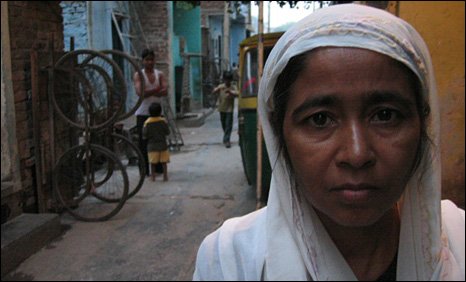
Sikh widow - What if this was your sister, or wife, or mother?
Thousands of people, including women and children pilgrims and about 157 soldiers, died.
Tanks too were employed to end the siege, leaving Sikhs highly aggrieved.
The eventual and possibly avoidable storming of the Golden Temple led to Mrs Gandhi receiving justice. The Sikh genocide was followed by widespread human rights abuses against Sikhs until 1994.
But the 1984 Delhi Sikh Genocide rocked the world, more so for the state's direct involvement and public justification of the blood-letting.
'Earth shakes'
Reacting to the continuing Sikh killings in Delhi and other places, newly appointed Prime Minister Rajiv Gandhi declared at a massive rally in the capital that "once a mighty tree falls, it is only natural that the earth around it shakes". Like mother, like son... A butcher for a butcher.
One of the worst massacres took place in two narrow alleys in the city's poor Trilokpuri colony where some 350 Sikhs, including women and children, were casually butchered over 72 hours.
The charred and hacked remains of the hundreds that perished in Trilokpuri's Block 32 on the smoky and dank evening of 2 November 1984 were stark testimony to the unimpeded and seemingly endless massacre.
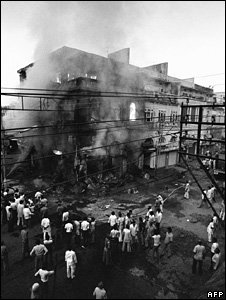
Sikh shops and establishments were targeted and burnt |
Soon after news of Mrs Gandhi's killing by her Sikh bodyguards spread, Hindu mobs swung into action - like they did elsewhere in the city armed with voters' lists - in Trilokpuri against the low caste Sikhs inhabiting one-roomed tenements on either side of two narrow alleyways barely 150 yards long.
With local police connivance they blocked entry to the neighbourhood with massive concrete water pipes and stationed guards armed with sticks atop them.
For the next three days marauding groups armed with cleavers, scythes, kitchen knives and scissors took breaks to eat and regroup in between executing their bloodthirsty mission.
When as a reporter, then with the Indian Express newspaper, Rahul Bedi along with two other colleagues visited the area on the eve of Mrs Gandhi's funeral, both lanes were littered with bodies, body parts and hair brutally hacked off, forcing them to walk precariously on tip-toe.
It was impossible to place one's foot flat on the ground for fear of stepping on either a severed limb or a body.
Earlier in the day two policemen on a motorcycle had emerged from Block 32 and reassured us that shanti or calm prevailed inside it and no untoward incident had occurred.
A few hours later on returning to the spot we saw that the entire area was awash with blood, a large proportion of it black coagulated mounds over which flies buzzed lazily.
Abject terror
It was also piled high in the open drains on either side of the tenements, never efficient at the best of times, alongside other human remains.
As we walked through this implausible slaughter in the light of hurricane lamps provided by some residents, the complete silence despite the large mob surrounding us was eerie.
No one spoke and nothing, except the bizarre, dancing shadows moved during this surrealistic interlude. Even one of the only survivors - a young polio-afflicted mother - holding her new born in her arms gazed sightlessly upon us.
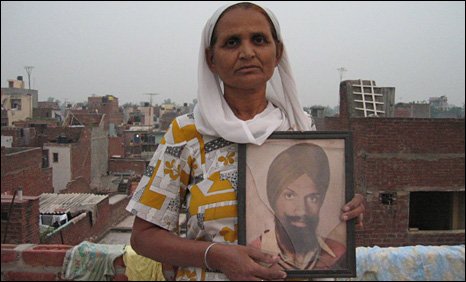
A widow of a victim of the Sikh Genocide riots with a picture of her husband
Her blank look momentarily changed into one of abject terror as we bent down to take her child to whom she fiercely clung. She probably took us to be the butchers who had massacred her entire family piled up high in the room behind her.
A whimper led us to a barely conscious young Sikh, hiding under a heap of bodies, his slashed stomach wrapped crudely around with a turban. All he wanted was water, parched after over 36 hours of concealing himself under the mound of corpses and bleeding steadily. He died soon after in hospital.
Some doors down a two-year-old girl, unmindful of the bodies, walked lazily over to us holding out her arms asking to be taken home. Unfortunately, she was home; but one littered with the bloated bodies of her parents and siblings killed two nights earlier.
Police arrived in Trilokpuri 24 hours later when the Indian Express revealed the horrific massacre. Sadly, there were no Sikhs left to protect.
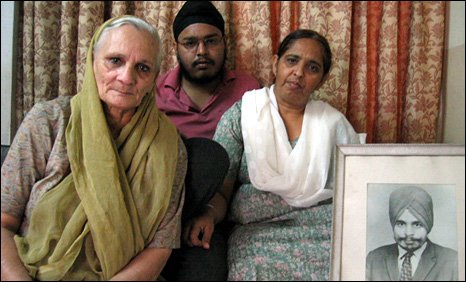
A family of a Genocide victims
Two inquiry commissions and seven investigative committees into the 1984 Sikh riots later no one has been held guilty for the Trilokpuri killings. Of the 2,733 officially admitted murders, only nine cases have so far led to the conviction of 20 people in 25 years; a conviction rate of less than 1%.
Credit: BBC (edited)
 Back to More Important Articles To Read

