



-

- DISCOVER SIKHISM
- SIKH GURUS
- Sikh Gurus
- Sri Guru Nanak Sahib Ji
- Sri Guru Angad Sahib Ji
- Sri Guru Amar Das Sahib Ji
- Sri Guru Ram Das Sahib Ji
- Sri Guru Arjan Sahib Ji
- Sri Guru Hargobind Sahib Ji
- Sri Guru Har Rai Sahib Ji
- Sri Guru Harkrishan Sahib Ji
- Sri Guru Tegh Bahadur Sahib Ji
- Sri Guru Gobind Singh Sahib Ji
- Sri Guru Granth Sahib Ji
- GURDWARAS
- SIKH LIBRARY
- DAILY HUKAMNAMA
- MORE
- KIRTAN
- LIVE TV
- ABOUT US

The Woodcutter and the Raja's Gift
A Raja's act of kindness toward a humble man becomes a profound lesson on the true value of life.
The Raja's Thirst: A Trial of Patience and Desire
Once upon a time, there lived a wise Raja who ruled over a vast and flourishing kingdom. One day, after a long and exhausting hunt deep within the forest, he found himself overcome with thirst. His throat burned, dry and aching, as he searched desperately for water.
As he rode through the dense forest, a steady, rhythmic sound broke the silence — the sharp strike of an axe against wood. Each echo carried through the trees, cutting through the stillness. The Raja thought, "Surely, a man working in such a remote place must have water with him." The scent of damp earth and fresh sap filled the air as he followed the sound, each strike growing louder.
At last, he came upon a woodcutter — a simple man, his face weathered by years of labor. He stood firm and steady, chopping at a large tree. Noticing the Raja, the woodcutter immediately stopped and bowed low.
The Raja spoke with urgency yet courtesy, "Good man, I have traveled far and I am parched. Will you share some water with me?"
Without hesitation, the woodcutter reached into his satchel and brought out a waterskin filled with cool, clear water. He offered it with both hands. The Raja drank deeply, the coolness soothing his throat and reviving his strength. He closed his eyes for a moment, savoring the relief.
As he lowered the pot, a thought stirred within him: "This man has given without question. Such kindness cannot be measured in wealth."
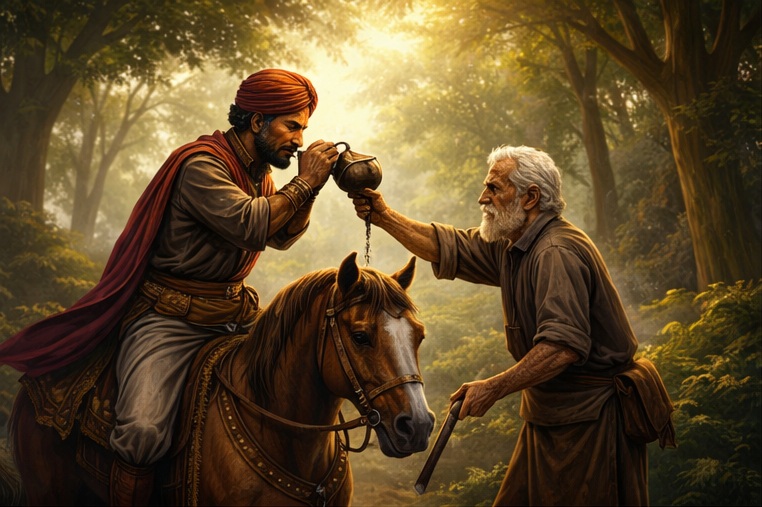
The Raja receives water from the woodcutter.
A Generous Reward: Recognizing Kindness and Grace
Moved by gratitude, the Raja considered how best to repay the woodcutter. After a brief pause, he said, "You have offered me more than water — you have shown me true kindness. Therefore, I grant you a reserve of this forest, rich with trees."
The woodcutter's eyes widened in disbelief. The Raja before him had given him a gift that meant he no longer needed to venture into the forest.
He bowed deeply once more. "Your kindness will live in my heart forever, great Raja."
With that, the Raja rode away, his thirst quenched and his spirit light, believing he had rewarded kindness wisely, while the woodcutter turned toward his newfound blessing.

The Raja gives the woodcutter a forest reserve.
The Grove of Opportunities: Prosperity and Responsibility
In the years that followed, the woodcutter lived well. He cut timber, made charcoal, and sold firewood in nearby villages. His life, once simple, had become comfortable.
But as time passed, so too did the trees.
The lush reserve slowly thinned. What was once vibrant and abundant grew sparse and barren. The woodcutter, now aged and weary, found his strength fading. Realizing his time had come to rest, he decided to sell his tools.
One morning, he carried his worn axe to the market. There, he met a merchant — a man of calm presence and discerning eyes.
"I wish to sell this axe," said the woodcutter. "What will you give me for it?"
The merchant examined it carefully before asking, "The iron holds little value… but tell me, what of the handle?"
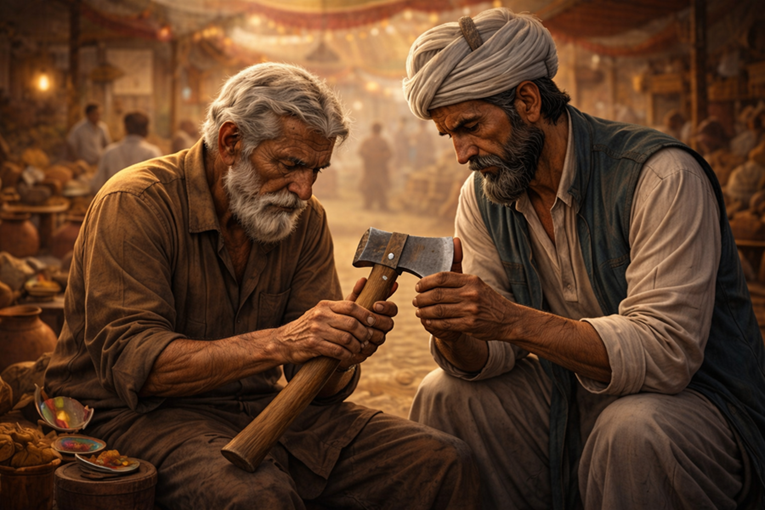
The woodcutter visits a merchant in the market.
The Hidden Value: Discovering Life's True Treasures
The woodcutter frowned in confusion. "Why the handle? It is only wood."
The merchant smiled gently. "Only wood? No, my friend. This is sandalwood — rare, fragrant, and highly valuable. The true worth of this axe lies not in its blade, but in what you have held all along."
The woodcutter stared at the handle. He remembered the day he had first claimed the reserve — how he had cut one of its finest trees to fashion a new handle for his axe. From that moment on, he had spent years turning precious wood into mere charcoal.
All those years… all those trees…
A heaviness settled in his chest. Tears welled in his eyes. "I did not know… I never understood its worth. I have cut down an entire forest of such trees, unaware of their value… and now, only this remains in my hands."
The Bitter Realization: Wisdom Gained Too Late
Silence fell between them.
The woodcutter's hands trembled as he turned the axe over. His mind raced with regret. What he had once seen as ordinary was, in truth, extraordinary.
He whispered, "I have lost more than trees… I have lost what was truly precious."
The merchant placed a gentle hand on his shoulder. "This is a lesson many learn, though often too late. We overlook what is most valuable, only to recognize it when it is gone."

The woodcutter realises the truth.
Moral of the Story: A Deeper Reflection
This story serves as a metaphor for human life:
The Sandalwood Trees: Represent the precious, limited days of human life and the spiritual potential given by the Divine.
The Charcoal: Represents the waste of time on fleeting pleasures, distractions, and trivial pursuits.
The Lesson: Just as the woodcutter burned valuable sandalwood for cheap charcoal, we too may spend our lives chasing temporary gains, failing to recognize the true spiritual worth of the life we have been given.
Teaching from the Guru Granth Sahib
This story reflects a profound teaching about the preciousness of human life — a rare opportunity for awareness, devotion, and selfless service.
ਮਨ ਸਾਸਿ ਸਾਸਿ ਸਿਮਰਹੁ ਪ੍ਰਭ ਊਚੇ ॥
Man saas saas simrahu parabʰ ooché ||
O mind, with each breath, remember the Divine.
ਜਿਹ ਪ੍ਰਸਾਦਿ ਪਾਈ ਦ੍ਰੁਲਭ ਦੇਹ ॥
Jih parsaaḋ paa▫ee ḋarulabʰ ḋéh ||
By grace, you have received this rare human life.
ਨਾਨਕ ਤਾ ਕੀ ਭਗਤਿ ਕਰੇਹ ॥੩॥
Naanak ṫaa kee bʰagaṫ karéh ||3||
O Nanak, devote yourself in remembrance.
~ Sri Guru Granth Sahib Ji, Guru Arjan, Ang 270
Just as the woodcutter failed to see what he truly possessed, we too can overlook the blessings of our lives — our time, relationships, and opportunities for growth — until they slip away.
Core Message
Material wealth is fleeting, and its pursuit can blind us to what truly matters.
What endures is inner peace, wisdom, and the joy found in compassion, humility, and service. True fulfillment lies not in accumulation, but in awareness and right action.
Each moment is a gift — a chance to nurture what is truly valuable before it is gone.
Reflective Closing
This story invites us to pause and reflect: What are we cutting down, unknowingly, in pursuit of temporary gain?
True joy lies not in possession, but in awareness, gratitude, and giving.
Every breath is an opportunity — to be present, to be mindful, and to protect the "trees" of our lives: our time, relationships, health, and inner peace.
Let us not wait, like the woodcutter, to understand their value — but honor the gift before it slips from our hands.
Key Takeaways:
◾ What seems ordinary may hold extraordinary value.
◾ Pursuit without awareness can lead to irreversible loss.
◾ True fulfillment lies in gratitude, service, and mindfulness.
◾ Human life is rare — use it wisely.
Reflection Question:
What in your life might you be overlooking today, that you may one day wish you had valued more?
 Back to Punjabi Folk Tales List