



-

- DISCOVER SIKHISM
- SIKH GURUS
- Sikh Gurus
- Sri Guru Nanak Sahib Ji
- Sri Guru Angad Sahib Ji
- Sri Guru Amar Das Sahib Ji
- Sri Guru Ram Das Sahib Ji
- Sri Guru Arjan Sahib Ji
- Sri Guru Hargobind Sahib Ji
- Sri Guru Har Rai Sahib Ji
- Sri Guru Harkrishan Sahib Ji
- Sri Guru Tegh Bahadur Sahib Ji
- Sri Guru Gobind Singh Sahib Ji
- Sri Guru Granth Sahib Ji
- GURDWARAS
- SIKH LIBRARY
- DAILY HUKAMNAMA
- MORE
- KIRTAN
- LIVE TV
- ABOUT US

The Mystery of 'Ba… Ja…'
A tale of greed, illusion, and the final truth of desire—revealed at the edge of death.
The Silent Man: A Life Hidden Behind Locked Doors
In a quiet Punjabi village lived a man known only as the Shahukar—a merchant defined not by generosity, but by his relentless greed. People believed he possessed immense wealth, gathered through years of trade, careful accumulation, and a substantial inheritance passed down from his grandfather. Yet despite this reputation, no one had ever truly seen his riches. His life remained closed off, guarded behind both physical and emotional barriers. The mystery surrounding him only deepened with time.
His house stood large and silent, its doors almost always locked from within, as though it guarded something more than ordinary possessions. Though his fields stretched wide across the land, they remained strangely untouched, reinforcing the belief that his wealth was hidden rather than lived. Rumours moved quietly through the village—of buried gold and secret chambers filled with treasure. No one knew the truth, not his neighbours, not his friends, and not even his own children. What should have been a life of security became a life of silence.
Over the years, curiosity within his family slowly transformed into expectation, and expectation hardened into quiet obsession. His sons and daughters no longer looked to him for guidance or wisdom, but for what he might one day leave behind. Conversations about him shifted from affection to speculation. Each passing year brought them closer to a moment they never spoke of openly, yet quietly anticipated. To them, his death was not an end, but a revelation waiting to happen.
Everyone believed that when the Shahukar finally passed away, his hidden fortune would be revealed. They imagined locked rooms opening, buried secrets uncovered, and wealth beyond expectation. His lifelong silence only strengthened their certainty that something extraordinary was concealed. What none of them questioned was whether that certainty itself was the illusion. Without realising it, they began waiting not for understanding—but for confirmation of desire.
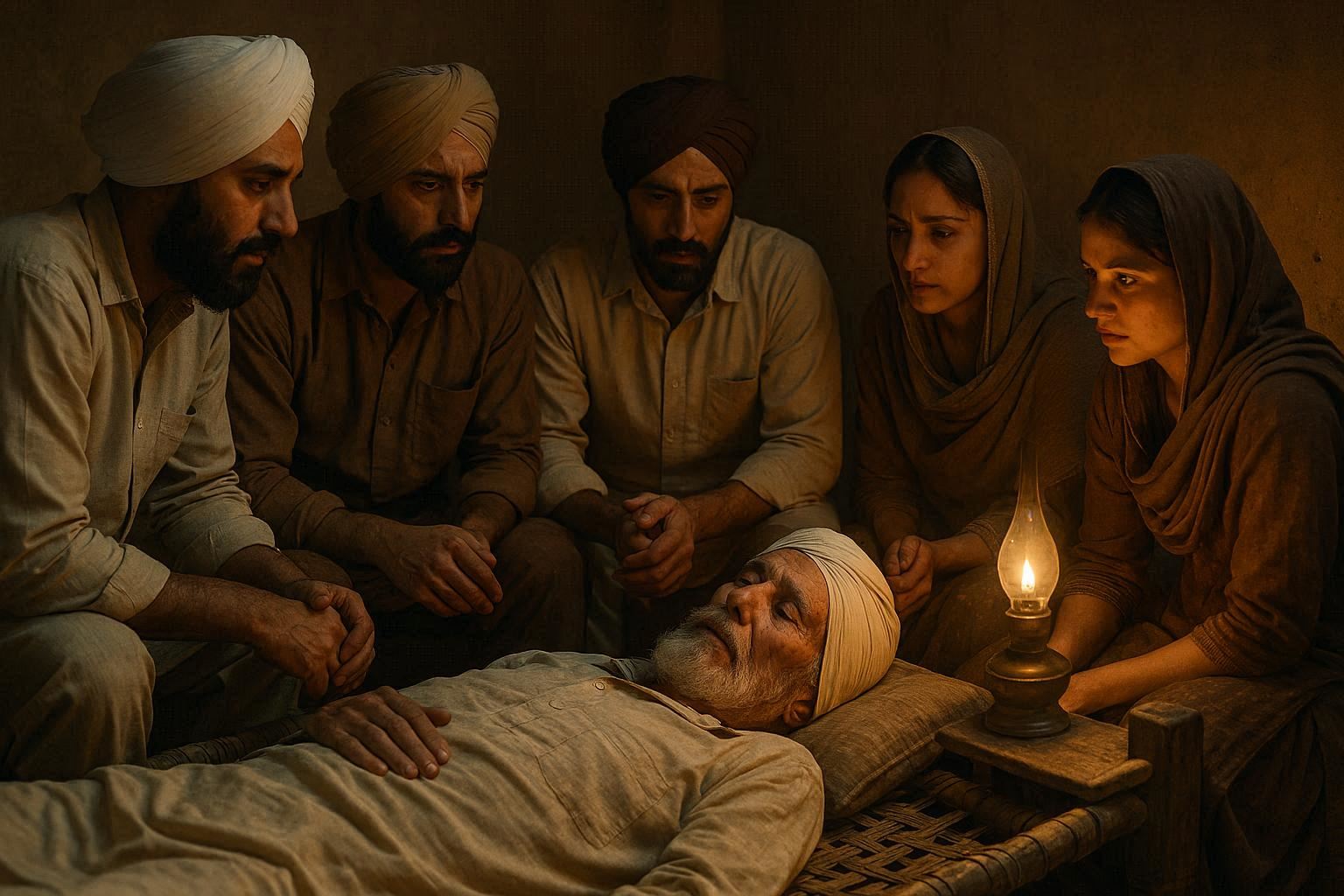
A lifetime of silence ends where it began—inside a room filled with waiting eyes and unspoken expectation.
The Final Illness: When Silence Begins to Speak
One winter morning, the Shahukar's health collapsed without warning. His body weakened quickly, his breathing became uneven, and he was left lying in silence, no longer able to speak or respond as he once had.
Days passed in a quiet tension as the family gathered around him. Some sat close, watching his face for any sign of recognition, while others lingered at a distance, speaking in low voices that never fully settled. Concern was present—but so was something else, less easily named. Not everyone waited for the same reason.
For a long time, he did not speak. His lips remained slightly parted, dry, as his breathing moved in shallow, uneven intervals. At times it seemed as though he might say something, but the effort dissolved before it formed. Once, his throat tightened and a faint sound escaped—unclear, unfinished—before he turned his head slightly and fell still again.
"ਬਾ…"
"Ba…"
"What did he say?" one son asked quietly, leaning forward, while another shook his head and muttered that it was nothing, just air. But his eldest daughter shifted closer, watching his mouth carefully, insisting in a low voice that he had been trying to say something.
He drew in a breath, slower this time, as if gathering what little strength remained. His lips moved again, but the sound broke midway, swallowed by the effort to breathe. A pause followed—not deliberate, but forced. When he tried again, the word came differently, less certain than before.
"ਬਾ… ਜਾ…"
"Ba… Ja…"
One of the younger sons whispered that it sounded like a name, perhaps a place, while another dismissed it outright, stepping back and saying he was no longer aware. The daughter did not move. She listened more closely now, repeating softly that he was trying to say the same thing again.
The Shahukar's chest rose sharply, then settled into a strained rhythm. His eyes opened, but they did not rest on anyone in the room. They moved past them, unfocused at first, then holding briefly on something beyond the doorway. It was unclear whether he recognized what he was seeing, or simply rested his gaze there.
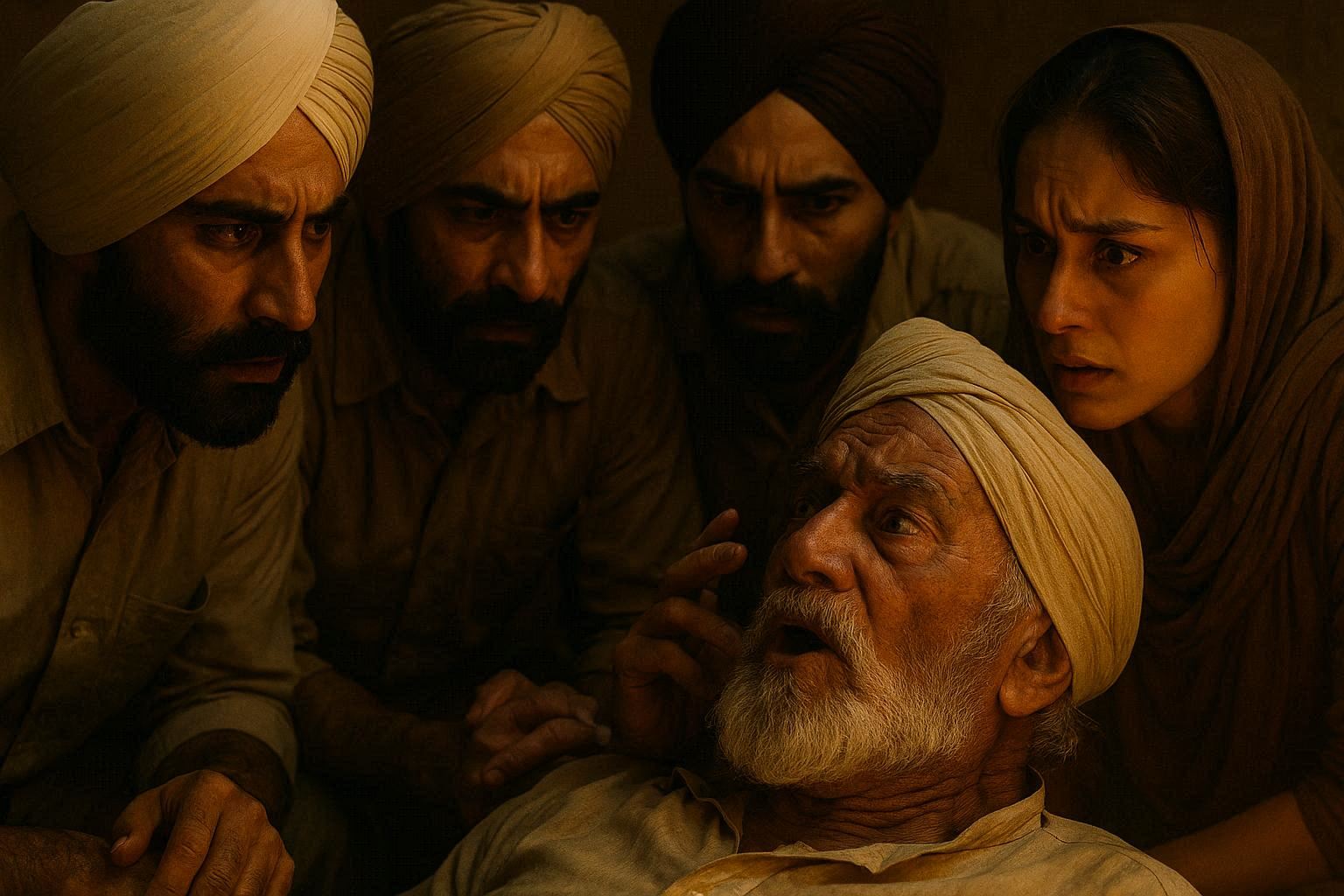
Not every ear hears the same meaning in a fading voice.
Someone suggested calling the doctor—not urgently, but with quiet uncertainty—and no one objected. When he arrived, he examined the Shahukar without haste, checking his pulse, his breathing, the response of his eyes. He did not ask what had been said. After a moment, he stepped back slightly and said that the man was very weak, that such sounds did not always carry meaning.
When one of the sons asked whether anything could be done to help him speak, the doctor paused before answering. He said they could try something, but it might not change anything, and if it did, it would not last. The decision was made without much discussion—not out of confidence, but out of reluctance to remain passive.
The medicine was given quietly. No one spoke while they waited. The room did not fill with anticipation so much as a strained stillness, as though each person was listening for something different.
After some time, a small movement returned—his fingers tightening slightly against the cloth beneath them. His breathing deepened, though not evenly, and his eyes opened again, this time more steadily, but still not directed at those around him.
He tried to speak once more. The first attempt failed entirely—only a breath, shaped like a word but not completing it. He swallowed, his throat tightening, and began again, not continuing the thought, but starting over.
"ਬਾ…"
"Ba…"
This time, no one interrupted. Even those who had dismissed it earlier remained quiet, watching more closely now.
He drew another breath—longer, strained—and forced the next sound forward, uneven but clearer than before.
"…ਜਾ…"
"…Ja…"
His gaze did not shift. It remained fixed beyond them, toward the open doorway. Whether he saw something clearly or only held onto the direction of it, no one could tell. The daughter followed his line of sight and murmured that he was looking outside, but no one moved to check.
The Final Moment: When Truth Refuses to Be Heard
The air in the room grew heavier as the moment everyone had been waiting for seemed finally within reach. The Shahukar's eyes were open, but they did not rest on his family or the faces gathered around him. Instead, his gaze moved past them, unfocused at first, then settling somewhere beyond the doorway. Whether he saw something clearly or simply held onto that direction, no one could tell.
His lips began to move again, slowly and with effort. The first attempt produced nothing—only a breath shaped like a word before it fell apart. He swallowed, his throat tightening, and tried again, not continuing the thought but beginning it over.
"ਬਾ…"
"Ba…"
No one spoke this time. Even those who had dismissed the earlier sounds remained still, watching more closely, as if waiting might make the meaning clearer.
He drew another breath, longer but uneven, and forced the next sound forward. It came out strained, less like a word than an effort to hold onto one.
"…ਜਾ…"
"…Ja…"
"What is that?" someone whispered, though no one answered. One son shook his head slightly, as if to dismiss it again, while the daughter leaned closer, trying to follow the shape of the sounds rather than the sounds themselves. The rest watched in silence, uncertain now whether they were listening for meaning or simply for any sign that he was still aware.
The Shahukar's breathing tightened suddenly, then steadied in short, strained intervals. His eyes remained fixed in the same direction, no longer drifting. There was a brief change in his expression—not clarity exactly, but a kind of urgency, as if something just within reach was being missed.
Then, with a sudden gathering of strength, he lifted his head slightly. The movement was small, but it carried effort. His voice, when it came, was uneven, breaking at the edges, but clearer than before—not controlled, but forced through the last of his breath.
ਬੇਵਕੂਫੋ… ਮੇਰੇ ਸਾਹਮਣੇ… ਵੱਛੜਾ… ਝਾੜੂ ਖਾ ਰਿਹਾ ਹੈ…
"Fools… in front of me… the calf… is eating the broom…"
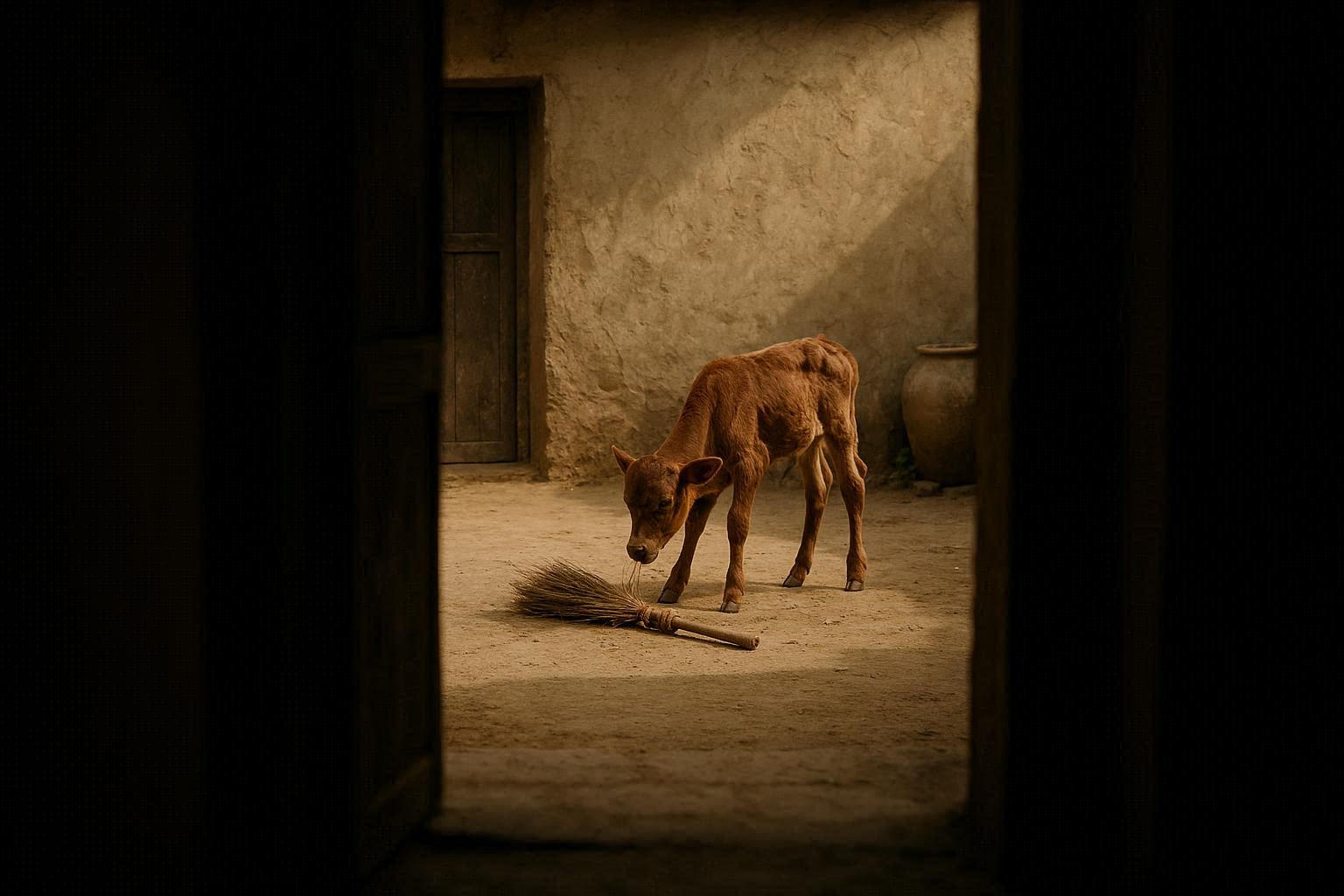
What was never hidden was simply never seen.
For a moment, no one reacted. The words seemed to settle slowly, not as meaning but as sound, as though they did not yet belong to what everyone had been expecting to hear. One of the sons frowned, as if trying to place the sentence into something larger, something that had not yet been revealed.
"What calf?" someone said quietly.
The daughter turned first, almost uncertainly, following the direction of his gaze toward the open doorway. She stepped closer, not hurriedly, but as if testing whether there was anything there at all. Outside, in the courtyard, a small calf stood near the wall, pulling at the frayed edge of a straw broom, chewing slowly, unconcerned.
She did not speak immediately. The others followed her movement, one by one, their attention shifting away from the bed for the first time. What they saw required no interpretation, yet it did not immediately replace what they had been expecting. For a few seconds, both possibilities seemed to exist at once.
"He… he was saying that?" one of them asked, not fully convinced. No one answered directly.
The fragments—"Ba…" and "Ja…"—never fully formed into speech. It was only afterward that their meaning became clear. In Punjabi, they pointed simply to what lay in front of him: ਵੱਛੜਾ (the calf) and ਝਾੜੂ (the broom). Realization spread slowly through the room, reaching each person at a different moment.
Behind them, the Shahukar's head had already fallen back. The effort had left him, and his breathing, which had briefly steadied, now thinned again into quiet intervals. By the time anyone turned back toward him, his eyes had closed.
Nothing more was coming.
The Realization: What Remains at the End 💫
In the stillness that followed his passing, the weight of what had just occurred settled slowly over the room. The expectation that had filled it for days did not collapse all at once—it faded unevenly, leaving behind something quieter and harder to name.
There was no hidden treasure, no final revelation waiting to be uncovered. What remained instead was a simple truth that had been overlooked in the search for something greater. In his final moment, the Shahukar had not revealed anything concealed—he had only spoken of what occupied his awareness.
That awareness had not formed in that moment. It had been shaped long before it, through repetition, habit, and attention. What appeared at the end was not new. It was familiar.
We do not think new thoughts at the end—we return to the ones we lived with.
In the Shahukar's final moments, his consciousness did not turn toward remembrance of the Divine or reflection upon life beyond. Instead, it remained fixed on what had dominated his attention in that instant—the calf and the broom in front of him. What the family saw as urgency was simply his attention still fixed on what lay in front of him and he unable to shift into awareness of something higher. What they interpreted as hidden meaning was simply the final expression of what his attention had been bound to.
Moral Lessons 🌟
◾ Human interpretation is shaped by expectation, not observation:
The family hears fragments ("Ba… Ja…") and immediately constructs meaning, showing how anticipation overrides direct perception.
◾ Attention determines what is noticed in critical moments:
While everyone searches for hidden significance, the actual event in the courtyard is overlooked until it is explicitly seen.
◾ Uncertainty creates competing interpretations within the same moment:
Different family members respond differently—dismissal, confusion, and over-analysis coexist without resolution.
◾ Absence of clarity in communication leads to projection:
Because speech is incomplete and broken, meaning is supplied by the listeners rather than the speaker.
◾ Final events are often reinterpreted through prior assumptions:
Even the Shahukar's last words are initially treated as symbolic, until reality interrupts interpretation.
Teaching from the Guru Granth Sahib 📖
The Guru Granth Sahib consistently points to a single inward principle: the state of consciousness at the end is not created in the final moment, but revealed through continuity of attention. What the mind repeatedly returns to becomes its natural resting point, even when the body loses strength.
ਥਾਕੇ ਨੈਨ ਸ੍ਰਵਨ ਸੁਨਿ ਥਾਕੇ ਥਾਕੀ ਸੁੰਦਰਿ ਕਾਇਆ ॥
Ṫʰaaké næn sarvan sun ṫʰaaké ṫʰaakee sunḋar kaa▫i▫aa ||
My eyes are tired, my ears are weary, my body is worn.
This verse reflects the collapse of physical faculties, yet it does not imply a parallel collapse of attachment. The body weakens, but the direction of consciousness continues along familiar patterns.
ਜਰਾ ਹਾਕ ਦੀ ਸਭ ਮਤਿ ਥਾਕੀ ਏਕ ਨ ਥਾਕਸਿ ਮਾਇਆ ॥੧॥
Jaraa haak ḋee sabʰ maṫ ṫʰaakee ék na ṫʰaakas maa▫i▫aa ||1||
Everything grows weary—but attachment does not.
This highlights the persistence of Maya as continuity of absorption rather than external force. Even as faculties decline, what the mind is attached to continues its momentum.
ਬਾਵਰੇ ਤੈ ਗਿਆਨ ਬੀਚਾਰੁ ਨ ਪਾਇਆ ॥
Baavré ṫæ gi▫aan beechaar na paa▫i▫aa ||
O mind, you did not understand.
ਬਿਰਥਾ ਜਨਮੁ ਗਵਾਇਆ ॥੧॥ ਰਹਾਉ ॥
Birṫʰaa janam gavaa▫i▫aa ||1|| rahaa▫o ||
This life is lost in vain.
~ Sri Guru Granth Sahib Ji, Bhagat Kabir, Ang 793
These lines do not describe condemnation but recognition: awareness that has remained outward-facing does not suddenly reorganize itself at the end. The teaching is structural, not emotional—it describes the trajectory of attention.
Within the story, this is mirrored precisely: the Shahukar's final awareness does not shift toward remembrance or inward clarity, but remains bound to immediate perception. The teaching and narrative converge here not as symbolism, but as alignment of continuity.
Core Message 💡
◾ Consciousness follows the trajectory of sustained attention rather than final intent:
The structure of awareness does not reorganize at the end of life; it continues along the patterns that have been repeatedly reinforced.
◾ What is experienced as "reality" is filtered through accumulated expectation:
The mind does not encounter events neutrally—it converts them into meaning shaped by prior desire, projection, and assumption.
◾ Distinction between appearance and interpretation collapses when awareness is externally driven:
When attention is outward-locked, perception and imagination merge, making simple reality appear as layered significance.
◾ Continuity, not transformation, defines the final state of awareness:
The ending of life does not introduce new consciousness; it reveals the uninterrupted direction in which consciousness has already been moving.
◾ What is not cultivated inwardly cannot emerge spontaneously at closure:
Depth of awareness is not a final achievement but a gradual formation; the final moment only reflects what has already been established.
Reflective Closing 🌿
In the Shahukar's final awareness, there was no shift toward abstraction or inward remembrance. Attention remained fixed on the immediate field of perception—the calf and the broom—because that was where consciousness had been continuously anchored.
This is not presented as judgement, but as reflection: the mind does not suddenly become something different at the end of life. It only reveals the direction it has been moving all along.
What we repeatedly attend to becomes what we meet in our final awareness.
Reflection Question:
If the mind simply continues its strongest pattern, what is it being trained to hold onto today?
 Back to Punjabi Folk Tales List