



-

- DISCOVER SIKHISM
- SIKH GURUS
- Sikh Gurus
- Sri Guru Nanak Sahib Ji
- Sri Guru Angad Sahib Ji
- Sri Guru Amar Das Sahib Ji
- Sri Guru Ram Das Sahib Ji
- Sri Guru Arjan Sahib Ji
- Sri Guru Hargobind Sahib Ji
- Sri Guru Har Rai Sahib Ji
- Sri Guru Harkrishan Sahib Ji
- Sri Guru Tegh Bahadur Sahib Ji
- Sri Guru Gobind Singh Sahib Ji
- Sri Guru Granth Sahib Ji
- GURDWARAS
- SIKH LIBRARY
- DAILY HUKAMNAMA
- MORE
- KIRTAN
- LIVE TV
- ABOUT US

The Merchant and the Illusion of Ownership 💰✨
This tale follows the slow unfolding of a life built on accumulation and control. Beneath its surface lies a quiet question about what it truly means to own anything. The story invites reflection on how fear often disguises itself as ambition.
The Story: The Merchant and the Wealth of the Soul 🏦
In a prosperous village lived a merchant whose name was known far beyond its borders, not only for his immense wealth but for his unending desire to expand it further. His estates stretched widely, and his influence reached distant markets where his word often carried weight. To many, he appeared successful and secure, a man who had mastered the art of accumulation. Yet beneath this polished image lived a constant inner restlessness that never allowed him peace.
Despite all he had gathered, the merchant carried a silent fear that rarely left him even in moments of comfort. He feared loss more than he valued gain, because loss threatened the identity he had built for himself. To him, wealth was not just comfort but a shield against uncertainty and vulnerability. In protecting it, he slowly began to confuse possession with safety and control with freedom.
His rise to power had come at a moral cost that he rarely acknowledged, even to himself. He had deceived relatives, bent agreements in his favor, and withheld what others rightly deserved, always justifying his actions as necessary for survival. Compassion became secondary to ambition, and generosity was treated as weakness rather than strength. Over time, these choices shaped not only his fortune but also the kind of man he was becoming.
Each night, he would sit alone with his coins, counting them as though repetition could secure permanence in an uncertain world. The sound of metal against metal became a ritual that reassured him more than human connection ever could. In those moments, he whispered to himself that as long as his wealth remained, nothing could truly harm him. Yet this belief, though comforting, slowly built the walls of his own confinement.
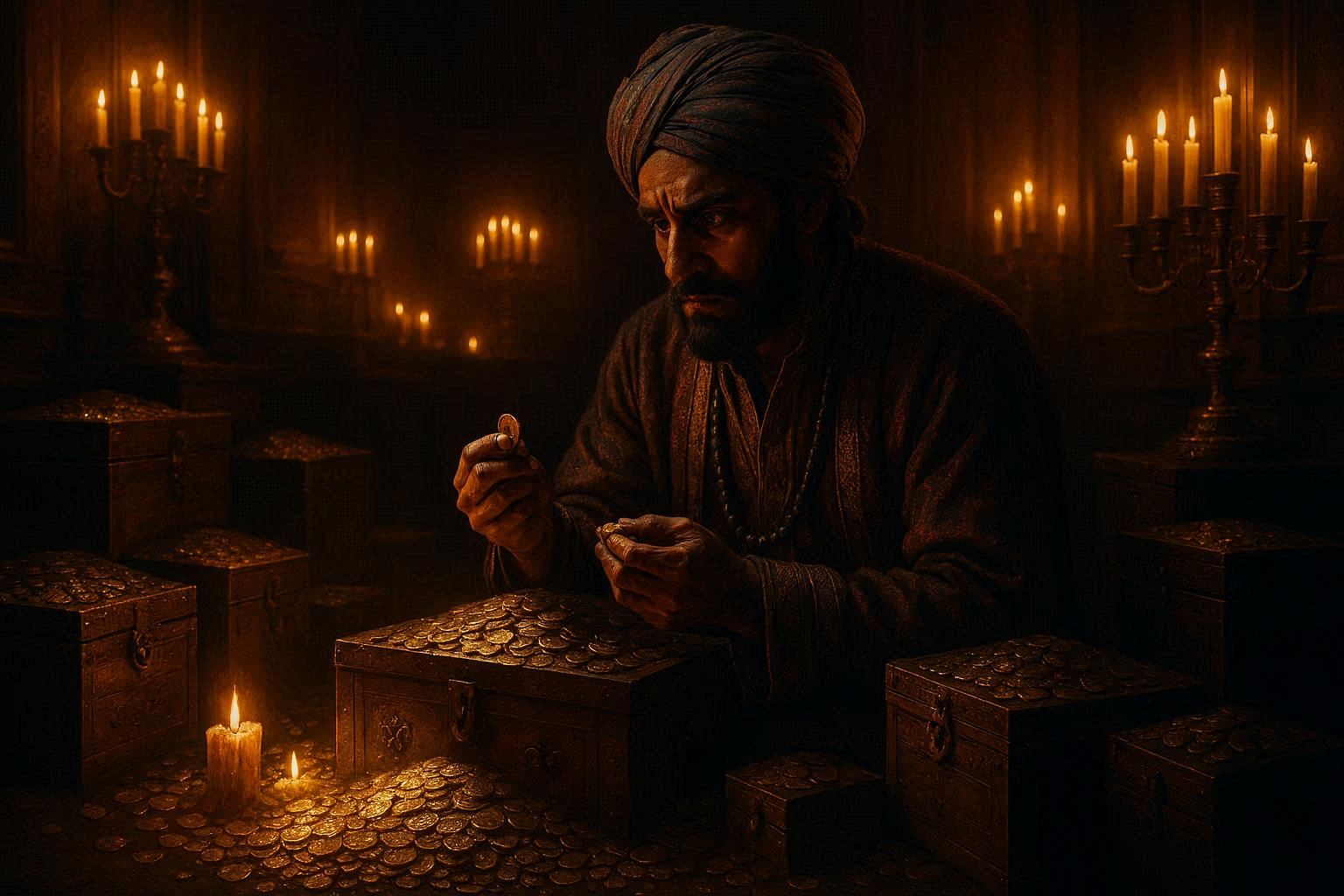
The merchant believed his wealth protected him—but it quietly imprisoned him.
The Illusion of Control 🏯
One day, a travelling sage arrived in the village, carrying a presence that felt calm yet deeply unfamiliar to those accustomed to ambition and noise. He walked barefoot, as if untouched by the urgency that governed others, and his gaze rested lightly on the world without attachment. When he entered the merchant's space, he did not admire the wealth or acknowledge its grandeur. Instead, he observed the man as though seeing something far beyond material possession.
The merchant, accustomed to reverence and admiration, dismissed the sage's presence with quiet irritation. He declared that his wealth gave him power, respect, and protection from uncertainty. In his understanding, identity and ownership were inseparable, and without his possessions he believed he would cease to matter. This belief had become so deeply rooted that it felt like truth rather than assumption.
The sage listened without resistance and then spoke gently, asking whether what he had gathered had truly freed him or quietly bound him instead. His question was not confrontational, but it carried a weight that unsettled certainty itself. The merchant responded with confidence, insisting that he controlled everything he had built. Yet the question lingered in the air as though it had found a place inside him.
As the exchange continued, the sage pointed toward a deeper uncertainty hidden beneath the merchant's confidence. He asked whether anything that could be taken away could ever truly be owned. The merchant laughed at the suggestion, believing control was proof of ownership. But the laughter was brief, as though it had been disturbed by something it could not fully dismiss.
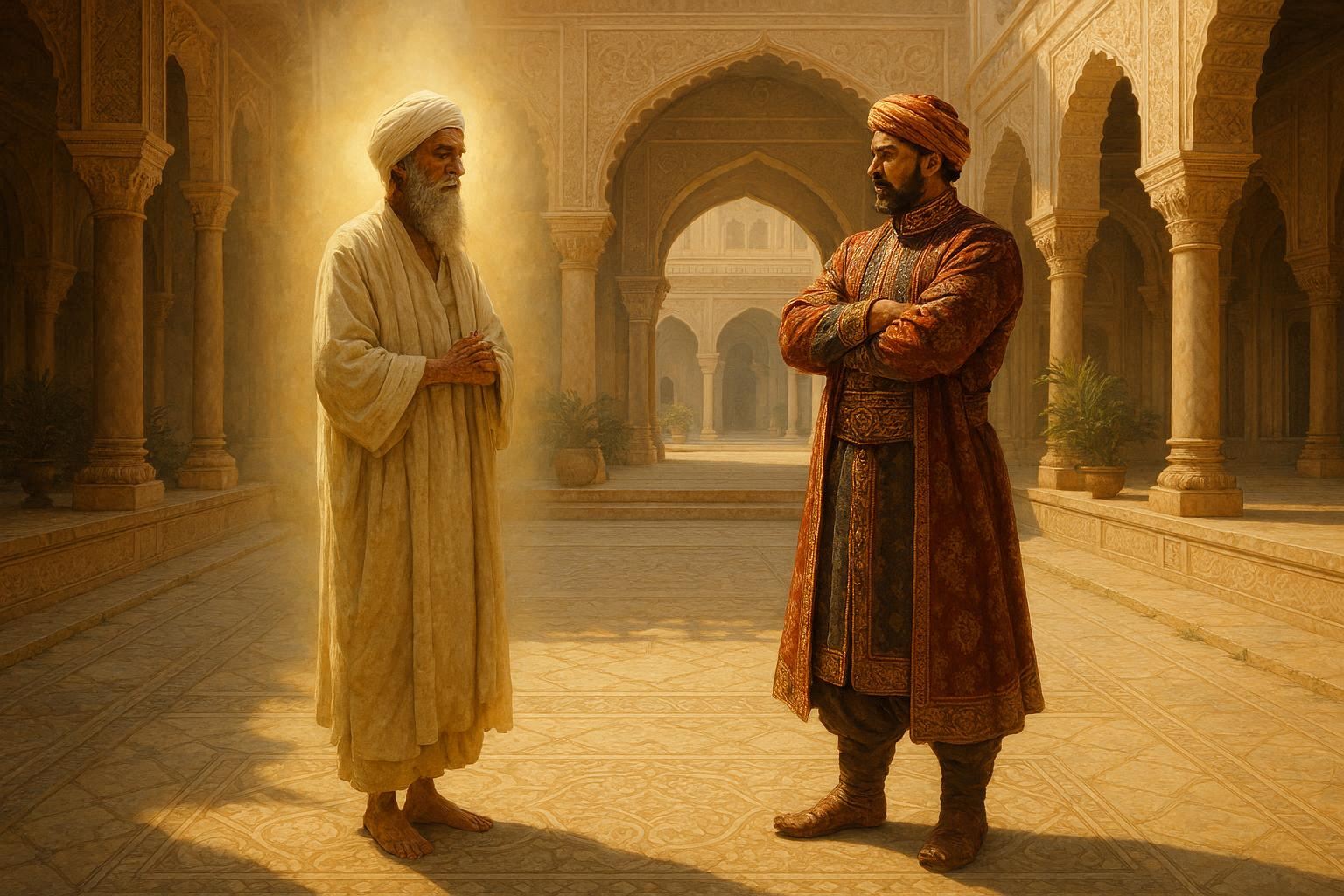
The sage did not bow like the others.
The sage finally left with words that felt less like a statement and more like an echo that would return later in life. He said they would meet again, not as a hope but as an inevitability shaped by time itself. The merchant dismissed him, believing such ideas held no power over his structured world. Yet something within him, however small, had already begun to shift.
The Expansion—and the Cracks ✈️
Driven by the need to reaffirm his control, the merchant expanded his trade across greater distances and riskier routes than ever before. His ships sailed across uncertain waters, and his caravans crossed lands that demanded endurance and faith. Wealth continued to flow into his hands, reinforcing his belief that expansion meant stability. Yet beneath this growth, subtle fractures began to appear.
Not all journeys ended as expected, and one of his valuable shipments was lost to a sudden and uncontrollable storm at sea. The merchant dismissed it as chance, refusing to assign meaning beyond randomness. However, loss has a way of returning in patterns that cannot always be ignored. With each passing event, certainty began to feel less absolute than before.
As his external empire grew stronger, something internal began to weaken in ways he did not immediately recognize. Meals lost their warmth, conversations felt distant, and laughter became less frequent in his presence. Even rest no longer felt restful, as though his mind remained locked in constant vigilance. The world around him still functioned, but his experience of it had changed.
Trust, once extended outward without hesitation, began to collapse inward, narrowing his circle of belief and connection. He started locking doors multiple times, as if repetition could guarantee safety. Suspicion replaced openness, not because others had changed, but because he no longer trusted the world he himself had shaped. In this way, isolation became the unintended companion of his success.
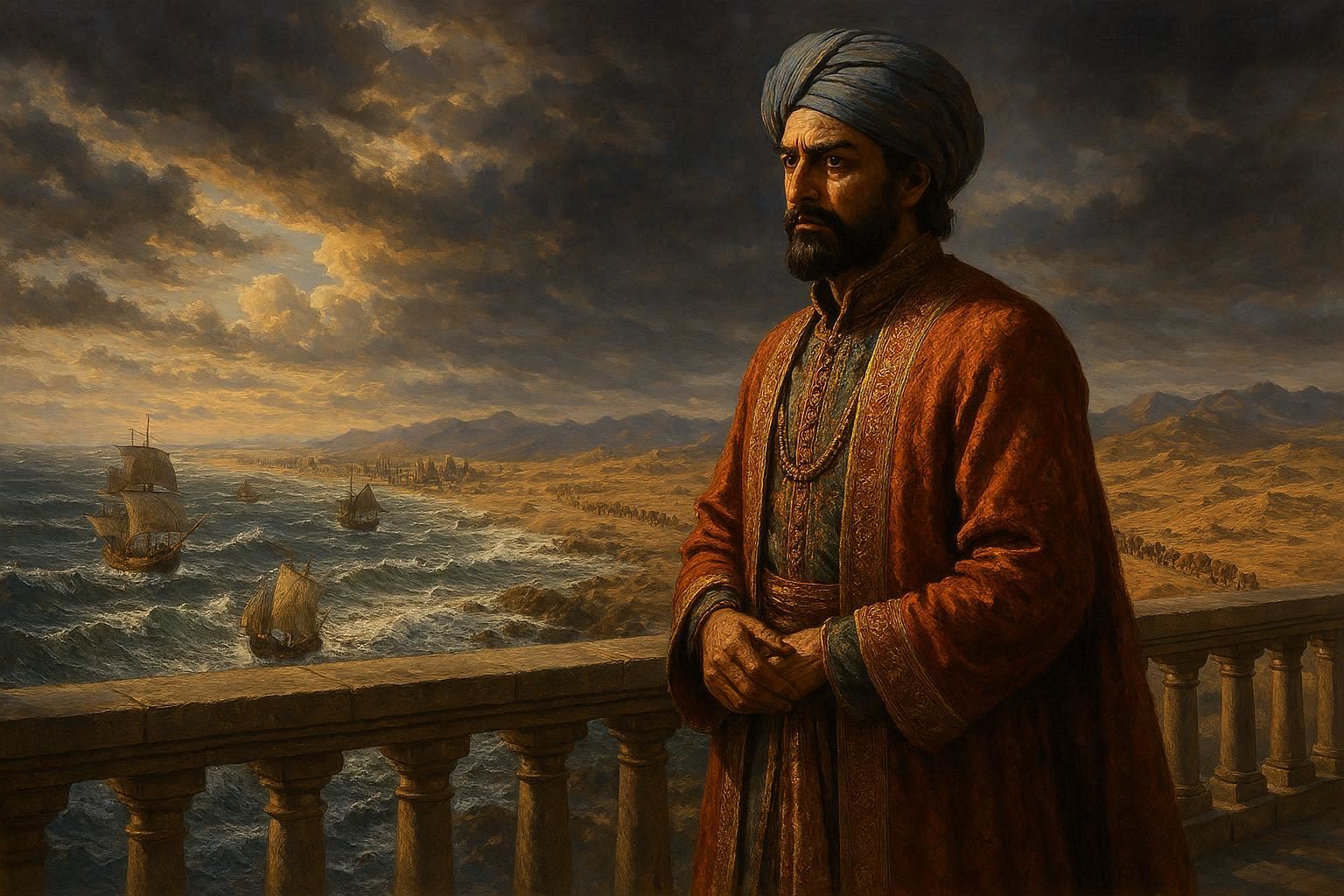
The merchant standing on a high balcony overlooking a vast trade empire.
The Cost of Obsession 🏋️♂️
The first clear rupture in his world came through a conversation that carried more truth than he was prepared to hear. A relative he had once wronged stood before him, not in anger, but in quiet refusal to continue business. The refusal was simple, yet it carried a finality that could not be negotiated. In that moment, the merchant encountered a consequence he could not control.
He was told that the decision was not based on his strength or influence, but on something deeper that could not be ignored. The relative described him not as powerful, but as empty, a statement that unsettled more than any financial loss. These words pierced through the structure of his identity in ways wealth could not repair. For the first time, success felt separate from worth.
As time passed, relationships that once supported his life began to dissolve quietly and without dramatic confrontation. People who once trusted him now spoke carefully, and emotional distance replaced familiarity. Even family interactions lost their ease, replaced by caution and restraint. The world around him had begun to mirror the way he had long treated it.
One evening, a servant's whispered observation reached his ears, noting how a man could possess everything yet still stand alone. The comment lingered longer than expected, refusing to dissolve into dismissal like other criticisms. It introduced doubt that he could neither fully accept nor fully reject. In that tension, the first cracks in self-perception became visible.
The Betrayal ⚠️
The turning point in his life arrived suddenly, not through enemies, but through someone he had trusted deeply within his own circle. A significant portion of his wealth disappeared overnight along with the associate responsible for managing it. There was no confrontation, no explanation, only absence where trust had once existed. The silence of loss felt heavier than its financial impact.
He reacted with anger, demanding answers that could restore his sense of control. Yet beneath the anger was an uncomfortable recognition that made him pause. The nature of the act felt familiar, not because he had experienced it before, but because he understood its logic too well. It reflected patterns he himself had once followed.
In that realization, something shifted within him that could not be easily undone. The idea of betrayal no longer felt external, but reflective, as though the world was revealing a version of himself he had refused to acknowledge. This recognition disturbed the simple narrative of victim and wrongdoer. It blurred the boundaries he had relied upon for understanding life.
For the first time, he began to question whether the world was acting against him or simply responding to what he had long contributed to it. This question did not bring immediate comfort, but it introduced a form of clarity he had never encountered before. It suggested that control was not as one-sided as he had believed. And with that thought, certainty began to loosen its grip.
The Storm 🌩️
During a journey undertaken to recover what he had lost, the merchant was caught in a violent and unrelenting storm. The winds tore through the land with force, and the rain blurred every attempt at direction or control. Nature, in its indifference, made no distinction between wealth and poverty. In that moment, all external status lost its relevance.
Alone and exposed, he clung tightly to a satchel of gold as if it could provide stability in chaos. Yet it offered no warmth against the cold, no shelter against the rain, and no reassurance against fear. The object he trusted most revealed its limitations without hesitation. His dependence on it suddenly appeared fragile and incomplete.
In the midst of this overwhelming uncertainty, an inner voice surfaced that felt both familiar and distant. It echoed the sage's earlier words, returning not as memory alone but as reflection. The idea that control could command permanence resurfaced in a moment of vulnerability. Yet now it sounded less like truth and more like question.
Through the storm, he briefly imagined the sage standing at a distance, unaffected by the chaos that surrounded him. This image did not bring comfort in a traditional sense, but it introduced contrast between attachment and detachment. The difference between clinging and being present became quietly visible. And in that contrast, something within him began to loosen.

The merchant clutches a small bag of gold tightly while trembling.
The Final Possession ⚰️
With time, the merchant's empire remained structurally intact, yet its emotional foundation never returned to stability. Age began to enter his life gradually, not as an event but as a continuous unfolding. Strength diminished in small, undeniable ways that could not be negotiated or reversed. What once felt permanent began to reveal its temporary nature.
He shifted his final sense of reliance onto his own body, believing it to be the last remaining possession under his control. Yet even this belief slowly eroded as physical decline became unavoidable. The realization that the body was also impermanent challenged his final illusion of ownership. What remained was not control, but observation of its disappearance.

The merchant now old and frail.
The Final Twist: The Moment of Departure ⚰️
The merchant lay on his deathbed, frail and alone, unable to deny the truth that had always lurked in the shadows of his consciousness. His body, once strong and commanding, now betrayed him with each slow, shallow breath. Yet in his hand, tightly clutched, was a small pouch of gold—his final possession, the last thing he could still control.
"If I could hold onto this," he thought, "perhaps something of me will remain. My wealth, my success... they must mean something, even now."
The coldness of the room seemed to seep into his bones, but the weight of the pouch was a small comfort—something solid, something real in the face of the unknown. It was the one thing that had never failed him, or so he believed.
"I've built all this," he whispered to himself, "I've made myself. This is mine. Nothing will take it from me." The words felt hollow, even as they left his lips. He tried to hold onto them, but they slipped away just as easily as his breath. For the first time, he saw them for what they were—empty, desperate words. They had always been, he realized, an illusion. He was no longer the strong man who commanded respect, who bent others to his will. He was simply a man, clinging to what he thought was his to keep.
His mind wandered back to moments of his youth, when ambition was a driving force, and the desire for more was a fire he could not control. Every deal, every compromise had led him here—to this bed, alone. No matter how much wealth he accumulated, no matter how many barriers he built to guard his possessions, it all seemed to slip through his fingers like sand.
"But I was strong," he mused. "I held on. I never let go."
The pouch in his hand felt heavier with every thought, as though it could anchor him to something permanent, something that would outlast this inevitable end. But even in his grip, the gold seemed to slip away, its surface cold and indifferent to his touch.
A quiet thought echoed in his mind, something he had not fully understood when the sage first spoke it: "What do you truly own?"
The question hovered in the silence, waiting for an answer that never came. It was not a question that demanded an immediate response, but one that slowly unraveled him from the inside out. The merchant's mind, once sharp and focused, now grappled with a truth too vast to comprehend.
"I thought I owned it all," he reflected bitterly, "but it was never mine. I was never in control."
And in that stillness, the realization began to seep through—his wealth, his empire, his power—none of it was truly his. It was never meant to be. All of it was temporary, subject to the very laws of impermanence that had governed his life without his acknowledgment. It was all borrowed, fleeting, like the breath that had just left him.
The pouch remained firmly in his grasp, but now it felt like a relic of a past self, a version of him that was fading with every second. His grip loosened as his strength waned. He could not hold onto it any longer—not the pouch, not the life, not the self he had worked so hard to build.
And then, as his final breath left him, the pouch of gold slipped from his hand, falling to the floor with a soft, hollow thud. There was no reverence in the sound—just the echo of what could no longer be held.
The world around him shifted, as it had done countless times before, indifferent to his passing. Those who would prepare his body moved with quiet efficiency, removing his possessions with the same calm detachment. What had been his, just moments before, was now gone, scattered, as easily as it had been acquired.
In that moment, the merchant understood. What was truly his had already been lost long ago. And it was not the gold that mattered, but the peace he had never allowed himself to seek.
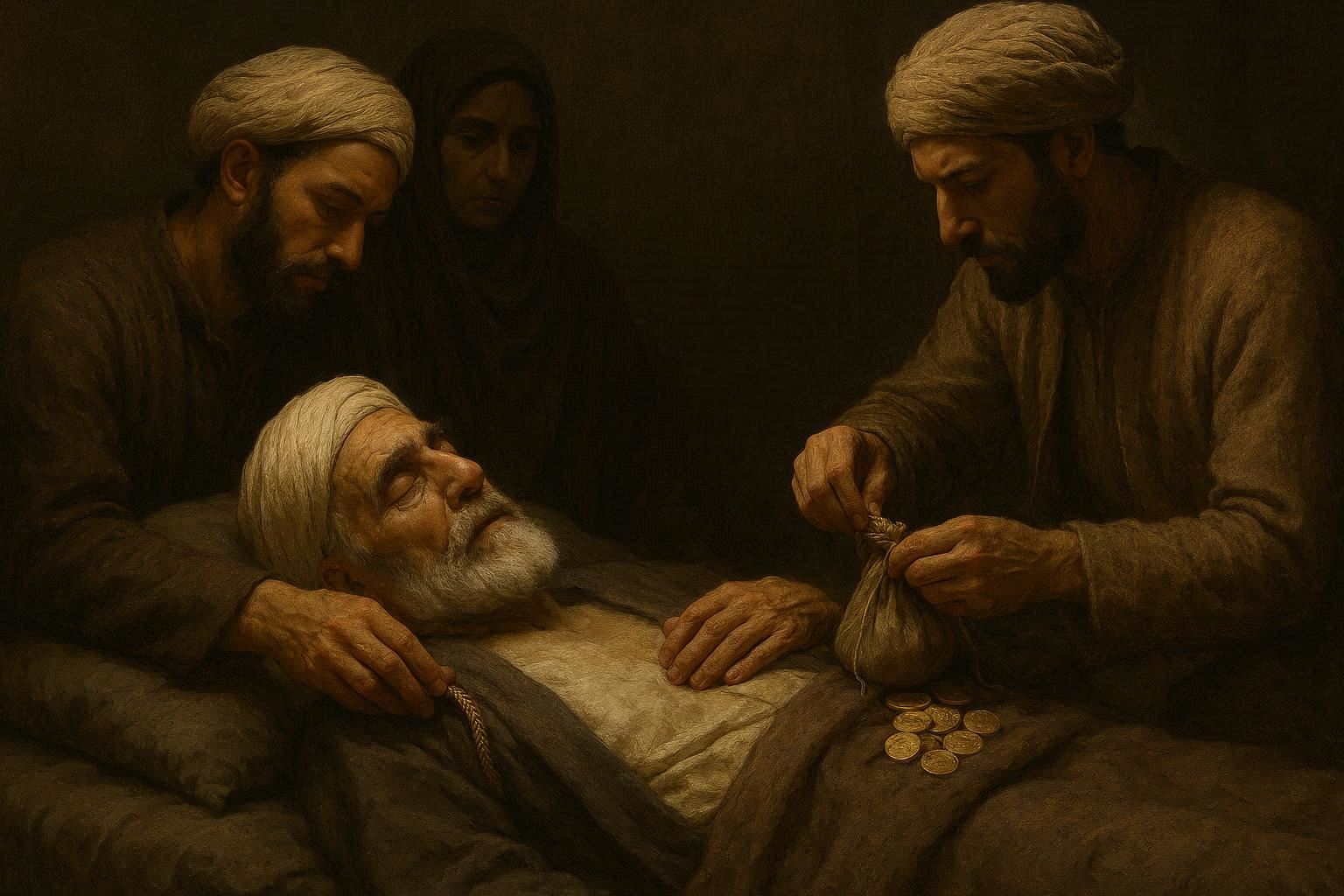
In death, even the smallest possession could not remain with him.
The Realisation Beyond Life 💫
In the silence that followed, the words once spoken by the sage resurfaced, no longer as distant memory, but as undeniable truth. The wealth he had sought, the power he had clung to—fleeting, like life itself. What had once felt abstract now carried the weight of experience.
The merchant's journey, when seen in full, revealed a pattern of accumulation that never resolved into peace. Everything he gathered eventually demonstrated its impermanence in one form or another. Yet he had continued to believe that persistence could overcome transience. This belief defined both his success and his suffering.
In his final awareness, the sage appeared not as an external figure but as a presence that represented clarity itself. The question he had once asked returned without urgency but with completeness. "What do you truly own?" echoed not as challenge but as revelation. And within that silence, the answer emerged without resistance.

What do you truly own?
Moral Lessons 🌟
◾ Ownership is temporary, not absolute:
What we call "mine" is only a brief association with things that are always changing. Wealth, status, and even the body are not fully controllable, and clinging to them can quietly replace freedom with fear.
◾ Actions eventually return in kind:
The merchant's patterns of deception and self-interest shaped the world around him. Life does not always "punish" directly, but intentions tend to echo back through circumstances and relationships.
◾ Ambition without awareness becomes emptiness:
When identity is built on accumulation, success can lose its depth. Fear can hide inside ambition, turning achievement into something isolating rather than fulfilling.
◾ What remains is how we relate to change:
Everything external shifts and eventually passes. The only lasting stability is inner awareness—the ability to witness change without being consumed by it. In that clarity, a quieter form of wealth appears.
Teaching from the Guru Granth Sahib 📖
This story reflects teachings from the Guru Granth Sahib Ji that remind us of the temporary nature of material accumulation and the importance of spiritual awareness. It emphasizes that what is gathered in life does not accompany the soul beyond its journey. True understanding lies in recognizing the limits of possession and the value of inner remembrance.
ਕਬੀਰ ਕੌਡੀ ਕੌਡੀ ਜੋਰਿ ਕੈ ਜੋਰੇ ਲਾਖ ਕਰੋਰਿ ॥
Kabīr ka▫udī ka▫udī jor kai jore lākh karor ||
Kabir! The mortal gathers wealth, shell by shell, accumulating thousands and millions.
ਚਲਤੀ ਬਾਰ ਨ ਕਛੁ ਮਿਲਿਓ ਲਈ ਲੰਗੋਟੀ ਤੋਰਿ ॥੧੪੪॥
Chaltī bār na kachh mili▫o la▫ī langoṭī ṯor ||
But when the time of his departure comes, he takes nothing at all with him. He is even stripped of his loin-cloth. ||144||
~ Sri Guru Granth Sahib Ji, Bhagat Kabir, Ang 1372
These verses emphasize that material wealth is temporary and cannot accompany the soul beyond life's final transition. What remains significant is not accumulation but awareness and spiritual alignment during one's lifetime. The teaching gently redirects attention from external possession toward inner understanding. In this way, it aligns closely with the merchant's realization at the end of his journey.
Core Message 💡
◾ The mind shapes its own reality:
The essence of the story is not about wealth, loss, or misunderstanding, but about the nature of the mind itself. What a person repeatedly thinks, values, and clings to gradually becomes the structure of their inner world. In the final moment, there is no sudden transformation of that structure—it simply reveals itself. The Shahukar's last words were not mysterious, but ordinary. They reflected continuity, not change.
◾ Change is not external but internal:
Seen from this perspective, the story becomes less about a single family's expectation and more about a universal human tendency. People often believe that meaning will appear at some decisive moment in the future, separate from how they live now. Yet what actually unfolds is shaped entirely by present attention and repeated thought. The future does not overwrite the past habits of the mind. It only continues them.
◾ Truth unfolds gradually:
This understanding removes the illusion that truth arrives dramatically at the end of life. Instead, it shows that truth is formed quietly, through daily awareness or lack of it. The Shahukar did not suddenly become who he was in his final breath—he simply expressed what had always been there. In the same way, every person carries forward the patterns they cultivate. The end is not a break, but a reflection.
◾ Freedom is cultivated over time:
Freedom, therefore, is not something that appears at the last moment, but something that is practiced long before it is needed. Awareness, attention, and reflection are not abstract ideas—they are ongoing disciplines that shape how life is experienced. Without them, the mind continues on its familiar path without interruption. With them, there is the possibility of clarity even in ordinary moments. The direction is always being formed, not decided at the end.
◾ The mind becomes what it holds:
What the story ultimately points to is a simple but often overlooked truth: the mind becomes what it repeatedly holds. There is no separate moment where everything resets or reorganizes itself. Instead, life is a continuous shaping of perception and thought. To recognize this is to take responsibility for one's present awareness. And in that recognition lies the possibility of change—before the final moment ever arrives.
Reflective Closing 🌿
What is truly yours is never what can be taken away, but what remains when everything else has already gone.
 Back to Punjabi Folk Tales List